A promissory note is a written promise from a borrower to repay a specific amount of money to a lender under agreed terms. It can document the amount borrowed, interest rate, repayment schedule, due date, and other conditions that explain how the debt will be repaid.
Using a written promissory note can make a lending arrangement clearer for both parties. Instead of relying on a verbal agreement or informal messages, the borrower and lender have a document that records the important details of the debt.
Promissory notes can be used in a variety of lending situations, including personal loans, business financing, private loans, and certain real estate transactions. The appropriate form and legal requirements can vary depending on the jurisdiction and type of transaction, so important or high-value arrangements should be reviewed carefully.
What Is a Promissory Note?
A promissory note is a written financial document in which the borrower, often called the maker, promises to pay money to a lender or other party entitled to receive payment. A typical note identifies the parties, states the amount owed, and establishes when and how repayment will occur.
A properly prepared note can provide a clear record of the debt and the agreed repayment conditions. Depending on the transaction and applicable law, a promissory note may also contain provisions addressing interest, late payments, default, prepayment, collateral, and other obligations.
Not every promissory note is necessarily a negotiable instrument. Under U.S. commercial law, negotiability depends on specific requirements under applicable law, including provisions of UCC Article 3.
Why Use a Promissory Note?
The primary purpose of a promissory note is to clearly document a repayment obligation. A written agreement can reduce misunderstandings by putting the important loan terms in one place.
- Documents the debt: The principal amount and repayment obligation are clearly recorded.
- Defines repayment terms: The parties can specify payment dates, installments, and the final due date.
- Records the interest rate: If interest applies, the agreed rate and related terms can be documented.
- Clarifies responsibilities: Both parties can understand their obligations before signing.
- Creates a written record: The signed document can serve as evidence of the agreement.
- Addresses default: The note can explain what happens if scheduled payments are not made.
For example, a private lender may provide a borrower with $10,000. Rather than relying on a verbal promise, the parties can create a promissory note specifying the $10,000 principal, interest rate, monthly payment amount, first payment date, final maturity date, and applicable default provisions.
What Information Should a Promissory Note Include?
The exact requirements depend on the transaction and applicable law, but a practical promissory note commonly contains several important sections.
Borrower Information
The note should clearly identify the borrower. This may include the borrower’s full legal name, address, and other identifying information appropriate for the transaction.
Lender Information
The lender or payee should also be identified clearly. Accurate names and addresses can help prevent confusion about who is entitled to receive repayment.
Principal Amount
The principal amount is the amount borrowed before applicable interest or other charges. It should be stated clearly, preferably in both numbers and words when appropriate.
Interest Rate
If the loan carries interest, the promissory note should identify the applicable interest rate and explain how interest is calculated when necessary.
Interest rates and lending charges may be subject to legal restrictions depending on the jurisdiction and type of loan. The parties should verify applicable requirements before finalizing the note.
Repayment Schedule
The repayment section should explain when payments are due and how much must be paid. A repayment schedule may specify monthly, quarterly, annual, or another agreed payment frequency.
Clear repayment terms are important because the borrower should be able to determine when payments are due and how the outstanding balance will be satisfied. Consumer credit regulations also emphasize disclosure of principal, payment timing, repayment periods, and other repayment terms in transactions covered by those rules.
Maturity Date
The maturity date identifies when the debt is scheduled to be fully repaid. Some notes require regular installments until a final payment, while others may provide for a single payment at maturity.
Default Provisions
A promissory note may describe what constitutes a default and what rights or remedies may apply if the borrower does not make payments as agreed.
Default provisions should be written clearly and should comply with applicable law. Avoid inserting penalties or charges without confirming that they are legally permitted.
Signatures
The borrower generally signs the note to indicate agreement to the written promise and terms. Depending on the transaction and local requirements, additional signatures, witnesses, notarization, or related documents may be appropriate.
How to Write a Promissory Note
Creating a promissory note starts with identifying the parties and then documenting the financial terms in a clear order.
1. Identify the Parties
Write the full legal names of the borrower and lender. Include addresses or other identifying information when appropriate.
2. State the Loan Amount
Clearly state the principal amount being borrowed. Avoid vague descriptions such as “the agreed amount.” The actual amount should appear in the document.
3. Define Interest
If interest applies, state the rate and any important calculation details. If the loan is interest-free, state that clearly instead of leaving the subject ambiguous.
4. Establish the Payment Schedule
Specify the payment frequency, payment amount, first payment date, and final due date. If the final payment may differ from the regular installments, explain how it will be calculated.
5. Add Relevant Terms
Depending on the transaction, additional provisions may address late payments, prepayment, default, acceleration, collateral, notices, dispute resolution, or other agreed conditions.
6. Review and Sign
Both parties should carefully review the document before signing. Each party should retain a complete copy of the signed note and any related agreements.
Secured vs. Unsecured Promissory Notes
A promissory note can be structured as either secured or unsecured, depending on the transaction.
Unsecured Promissory Note
An unsecured note does not specifically use collateral to secure the repayment obligation. The lender relies primarily on the borrower’s promise and any remedies available under the agreement and applicable law.
Secured Promissory Note
A secured arrangement involves collateral that may support the repayment obligation. The promissory note may be accompanied by a separate security agreement or another document establishing the lender’s security interest.
For example, a business loan may involve a promissory note together with a security agreement or guaranty. These documents can serve different purposes and should not automatically be treated as interchangeable.
Promissory Note Payment Terms
Payment terms are one of the most important parts of the document. A borrower should be able to understand exactly what must be paid, when payments are due, and when the debt will be completely satisfied.
A payment schedule may include:
- First payment due date
- Regular payment amount
- Payment frequency
- Interest rate
- Number of scheduled payments
- Final maturity date
- Final or balloon payment, if applicable
- Accepted payment method
- Late payment provisions
- Prepayment terms
Clear repayment information is also important in consumer lending contexts. The CFPB notes that a promissory note can contain details such as the amount owed, interest rate, payment dates, total amount paid, repayment length, payment location, and consequences of failing to make required payments.
What Happens If a Borrower Does Not Pay?
If a borrower fails to make payments, the consequences depend on the terms of the note and applicable law. A promissory note may contain provisions explaining what constitutes default and what actions may be available to the lender.
Depending on the situation, the lender may have legal options to seek repayment. If the note is secured, separate collateral and security-interest rules may also apply.
Because enforcement procedures and limitation periods can vary by jurisdiction, a lender should not assume that every promissory note can be enforced in exactly the same way. For a significant debt or disputed situation, professional legal advice may be appropriate.
Promissory Note vs. Loan Agreement
A promissory note and a loan agreement are related but can serve different purposes.
A promissory note primarily documents the borrower’s promise to repay money and establishes the repayment obligation. A broader loan agreement may contain more extensive provisions governing the overall lending relationship, including representations, conditions, covenants, collateral, insurance, events of default, and other contractual obligations.
In some transactions, the parties may use both documents. The appropriate structure depends on the type and complexity of the loan.
Common Promissory Note Mistakes
Even a simple loan document can create problems if important terms are unclear or inconsistent. Avoid these common mistakes when preparing a promissory note.
- Leaving the loan amount unclear: State the exact principal amount.
- Omitting the interest rate: Clearly state whether interest applies.
- Using vague payment dates: Use specific dates or a clearly defined schedule.
- Failing to identify the parties: Use accurate legal names.
- Ignoring default provisions: Address what happens if payments are missed.
- Adding unlawful terms: Verify that interest rates, fees, and penalties comply with applicable law.
- Failing to keep copies: Both parties should retain the signed document.
- Assuming one template works everywhere: Requirements can differ by jurisdiction and transaction type.
Tips for Using a Promissory Note Template
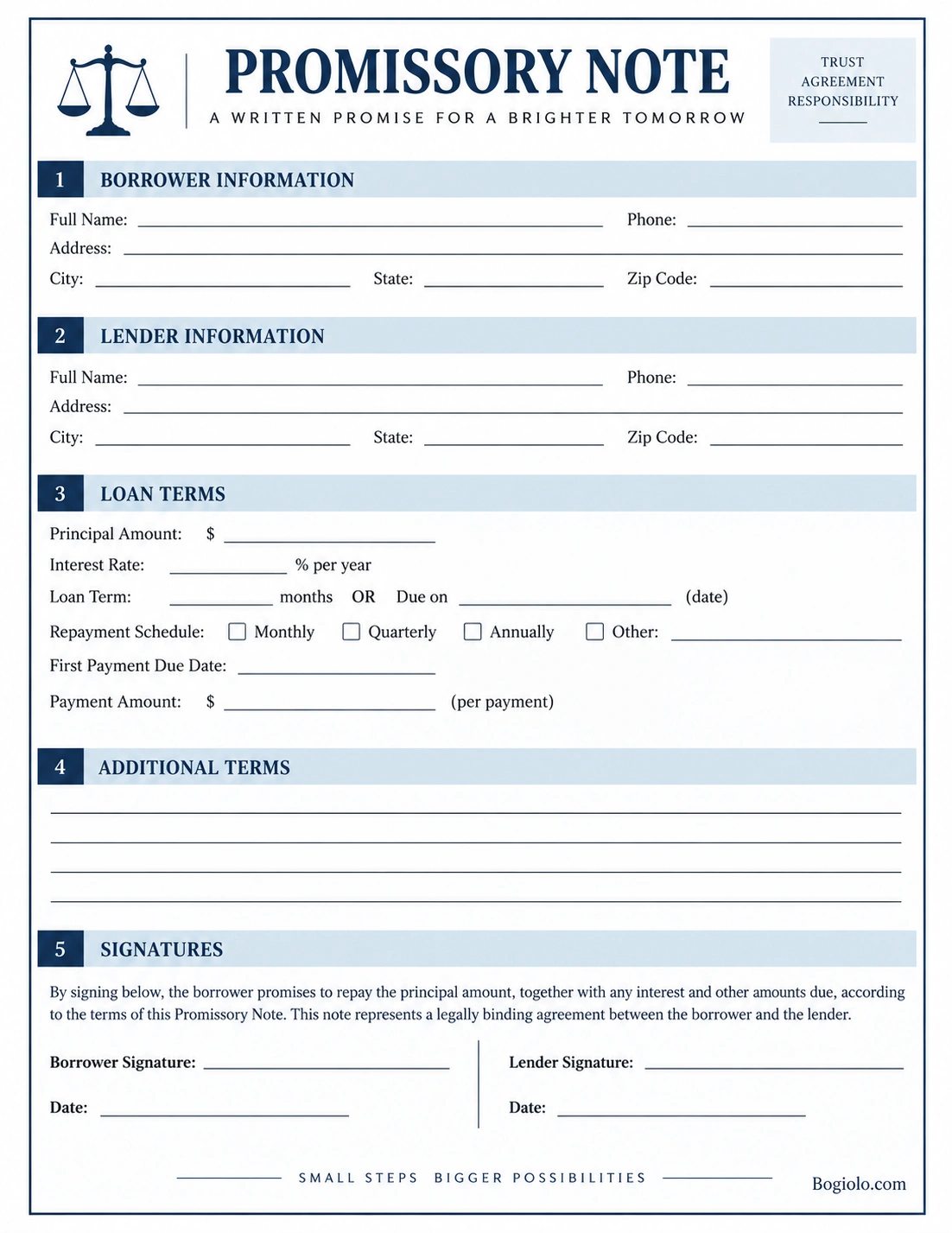
A promissory note template can provide a convenient starting structure for documenting a loan. A template can help organize borrower information, lender information, loan terms, repayment details, additional provisions, and signatures.
However, a template should be customized to reflect the actual transaction. Do not leave important blanks unresolved or include provisions that do not apply.
Before signing, check the principal amount, interest rate, payment schedule, maturity date, default terms, and signatures. Make sure the information is consistent throughout the document.
For transactions involving significant amounts of money, collateral, businesses, real estate, multiple borrowers, guarantors, or unusual repayment arrangements, consider having the document reviewed by a qualified attorney in the applicable jurisdiction.
Promissory Note Checklist
Use the following checklist when preparing a promissory note:
- Identify the borrower.
- Identify the lender or payee.
- State the principal amount.
- Specify the interest rate, if applicable.
- Set the payment frequency.
- State the payment amount or calculation method.
- Set the first payment date.
- Set the maturity or final payment date.
- Address late payments and default.
- Include prepayment terms if needed.
- Identify collateral if the loan is secured.
- Review applicable legal requirements.
- Obtain the required signatures.
- Give each party a complete copy of the signed document.
Final Thoughts
A promissory note provides a structured way to document a borrower’s promise to repay money. By clearly recording the principal amount, interest, repayment schedule, due dates, and other important terms, the document can help both parties understand their responsibilities.
A good promissory note should be specific, consistent, and appropriate for the transaction. A printable promissory note template can make it easier to organize the required information, but the template should always be reviewed and adapted to the circumstances.
Because laws governing loans, interest, signatures, collateral, and enforcement can vary, a template should not be treated as a substitute for jurisdiction-specific legal advice when the transaction is important or complex.
Download: Promissory Note Template
