Project scope defines what a project is expected to accomplish and, just as importantly, what is outside the project’s boundaries. It provides a clear framework for identifying project goals, deliverables, tasks, resources, costs, deadlines, and requirements before substantial work begins.
A well-defined project scope helps project teams understand what needs to be completed, who is responsible for the work, and what outcomes are expected. It can also help reduce misunderstandings, control changes, and keep the project aligned with its original objectives.
Whether you are managing a software development project, marketing campaign, construction project, business initiative, or small internal task, creating a clear scope can make planning and execution much easier.
What Is Project Scope?Project scope describes the complete set of work required to achieve a project’s defined objectives. It establishes the project’s boundaries by identifying what will be included and what will not be included.
A project scope can cover the project’s goals, deliverables, requirements, activities, resources, assumptions, constraints, deadlines, and acceptance criteria. The exact contents depend on the size and complexity of the project.
For example, if a company is developing a new website, the project scope might include website design, page development, content migration, testing, and launch. It might specifically exclude ongoing content creation or post-launch marketing unless those activities are separately approved.
Why Is Project Scope Important?
A clear scope gives everyone involved a shared understanding of the project. Without defined boundaries, teams can gradually take on additional work that was not included in the original plan.
Establishing project scope can help:
- Clarify project objectives.
- Define expected deliverables.
- Identify the work required to complete the project.
- Establish project boundaries.
- Support accurate scheduling.
- Improve cost estimation.
- Clarify team responsibilities.
- Manage stakeholder expectations.
- Provide a reference for evaluating proposed changes.
- Support project monitoring and control.
A well-defined scope does not prevent every project problem, but it provides a useful foundation for making planning and change decisions.
Key Elements of a Project Scope
A project scope document can contain several important components. Including these elements helps turn a general project idea into a more structured plan.
Project Objectives
Project objectives describe what the project is intended to accomplish. Objectives should be specific enough that the team can determine whether the project has achieved its intended outcome.
For example, instead of saying “improve the company’s website,” an objective might specify that the project will redesign the website’s main pages, improve navigation, and launch the updated site by a particular date.
Project Deliverables
Deliverables are the tangible or measurable outputs that the project is expected to produce. Depending on the project, deliverables may include reports, software, designs, products, training materials, documentation, or completed installations.
Each major deliverable should be described clearly enough that stakeholders understand what they will receive.
Project Tasks
Tasks are the activities required to produce the project’s deliverables. Breaking major deliverables into smaller tasks can make scheduling and assigning responsibilities easier.
For example, a website project might include tasks such as creating wireframes, designing page layouts, developing templates, entering content, testing forms, and reviewing the final site.
Project Requirements
Requirements describe the conditions, features, specifications, or standards that the project must satisfy. They may come from customers, stakeholders, regulations, technical specifications, or internal business needs.
Project Timeline
The timeline establishes important dates and milestones. It can include the planned start date, major milestones, deadlines, testing periods, review dates, and expected completion date.
Project Costs
Project scope can also identify expected costs or budget considerations. These may include labor, materials, software, equipment, contractors, services, and other project expenses.
Scope Boundaries
Scope boundaries clarify what is included and excluded from the project. This section is particularly useful for preventing assumptions about work that was never part of the original agreement.
Project Scope vs. Project Objectives
Project objectives and project scope are closely related but serve different purposes.
Project objectives describe what the project aims to achieve, while project scope describes the work and boundaries involved in achieving those objectives.
For example, the objective of a project might be to launch a new customer portal. The scope could define the portal’s features, supported devices, user authentication, testing requirements, documentation, launch activities, and specific exclusions.
Clear objectives help define the desired outcome, while clear scope helps define the work required to reach that outcome.
How to Create a Project Scope
Creating a project scope does not have to be complicated. The process can be broken into several practical steps.
1. Define the Project Purpose
Start by explaining why the project is being undertaken. Identify the problem, opportunity, or business need that the project is intended to address.
2. Identify the Main Objectives
Write down the specific outcomes the project should achieve. Keep the objectives focused and measurable where possible.
3. List the Deliverables
Identify the products, services, documents, systems, or other outputs that the project will produce.
4. Identify Required Tasks
Break each major deliverable into the work required to complete it. This creates a foundation for scheduling and resource planning.
5. Define Requirements
Document important functional, technical, quality, business, or regulatory requirements that must be satisfied.
6. Establish Boundaries
Clearly state what is included in the project and what is excluded. This is one of the most important steps in preventing uncontrolled expansion of the work.
7. Estimate Resources and Costs
Determine what people, tools, materials, technology, and budget will be required to complete the defined work.
8. Establish the Timeline
Identify major milestones and deadlines. The schedule should be realistic based on the defined scope and available resources.
9. Define Acceptance Criteria
Explain how stakeholders will determine whether deliverables are complete and acceptable. Clear acceptance criteria can reduce disagreements at the end of the project.
10. Review the Scope With Stakeholders
Before work begins, review the scope with the people responsible for approving, managing, and completing the project. Resolve unclear requirements before they become problems during execution.
In-Scope and Out-of-Scope Work
One of the most useful practices in project planning is separating in-scope work from out-of-scope work.
In-Scope Work
In-scope work includes everything that the project team is expected to complete as part of the approved project.
Examples might include:
- Designing specified project components.
- Developing agreed features.
- Creating required documentation.
- Testing defined deliverables.
- Completing approved installations.
Out-of-Scope Work
Out-of-scope work includes activities that are not part of the approved project. Clearly documenting exclusions can prevent stakeholders from assuming that additional work is automatically included.
For example, a website redesign project might include design and development but exclude ongoing search engine optimization, social media management, or future feature development.
What Is Scope Creep?
Scope creep occurs when additional requirements, tasks, or deliverables are gradually added to a project without corresponding adjustments to the project’s schedule, resources, budget, or approval process.
Small additions can appear harmless individually, but numerous changes can significantly affect the project.
Common examples include:
- Adding new features after development has started.
- Expanding the number of deliverables.
- Requesting additional revisions without adjusting deadlines.
- Adding new stakeholders’ requirements late in the project.
- Expanding the project into areas that were originally excluded.
A clearly documented scope provides a reference for evaluating whether a requested change is part of the original project or requires formal approval.
How to Manage Changes to Project Scope
Changes are not necessarily bad. Projects often need to adapt to new information, business priorities, technical discoveries, or stakeholder requirements. The important issue is managing those changes systematically.
When a change is proposed, consider:
- What exactly is changing?
- Why is the change needed?
- Does it affect the project objectives?
- How much additional work is required?
- Will the budget change?
- Will the deadline change?
- Are additional resources required?
- Does the change affect other deliverables?
- Who needs to approve the change?
Documenting approved changes helps maintain a reliable record of the project’s current scope.
Project Scope Example
Consider a project to launch a small business website.
The project objective may be to create and launch a responsive five-page website that provides information about the business and allows visitors to submit a contact form.
The scope might include:
- Homepage design and development.
- About page.
- Services page.
- Contact page.
- Responsive design for desktop and mobile devices.
- Contact form setup.
- Basic testing.
- Website launch.
The scope might exclude ongoing content writing, advertising campaigns, social media management, advanced analytics, and future feature development.
This example demonstrates how defining boundaries can make it easier for everyone to understand what the project is expected to deliver.
Benefits of Using a Project Scope Template
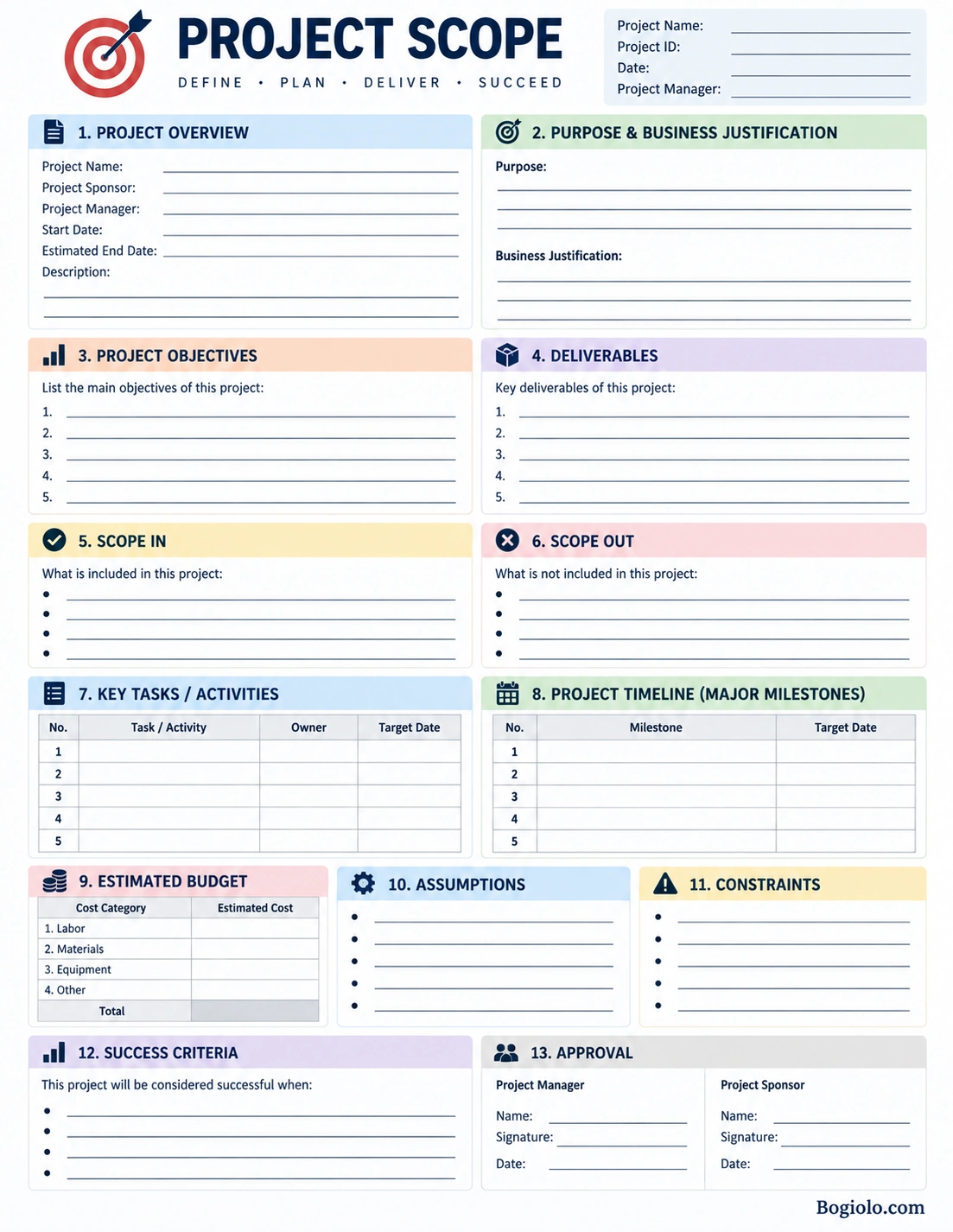
A project scope template provides a structured starting point for documenting important project information. Instead of creating a scope document from an empty page, project managers can work through predefined sections.
A printable project scope template can be especially useful during planning meetings, project kickoff sessions, or early discussions with stakeholders.
Common sections may include:
- Project name and description.
- Project objectives.
- Deliverables.
- Tasks and activities.
- Requirements.
- Timeline and milestones.
- Budget and estimated costs.
- Resources.
- In-scope work.
- Out-of-scope work.
- Assumptions and constraints.
- Acceptance criteria.
- Approval and sign-off.
Tips for Writing a Clear Project Scope
A useful scope should be detailed enough to create clarity without becoming unnecessarily difficult to maintain.
- Be specific: Use clear descriptions instead of broad statements.
- Define measurable outcomes: Explain how completion will be recognized.
- Document exclusions: Clearly identify work that is not included.
- Use realistic deadlines: Match the schedule to available resources.
- Involve stakeholders: Review the scope with the people affected by the project.
- Document assumptions: Record conditions that the project depends on.
- Keep the document accessible: Make sure relevant team members can reference the current version.
- Update approved changes: Keep the scope aligned with formally approved project changes.
Common Project Scope Mistakes
Several common mistakes can make a project scope less effective.
Being Too Vague
A statement such as “improve the product” does not provide enough information to establish the required work. More specific objectives and deliverables are easier to plan and evaluate.
Ignoring Exclusions
Only documenting what the project includes can leave room for assumptions. Listing important exclusions helps clarify the project’s boundaries.
Creating Unrealistic Deadlines
A scope should be consistent with the resources available. An ambitious list of deliverables combined with an unrealistic deadline can create problems during execution.
Failing to Update Approved Changes
If significant changes are approved but the scope is never updated, different team members may work from different assumptions about the project.
Project Scope and Project Success
Project scope is closely connected to planning, scheduling, budgeting, resource allocation, and stakeholder communication. A clear scope makes it easier to determine what work should be prioritized and how progress should be evaluated.
It can also provide a useful baseline for comparing the original plan with the project’s actual progress. When changes occur, the team can evaluate their effect against the original scope rather than relying on memory or informal conversations.
Final Thoughts
Project scope provides the boundaries and structure needed to understand what a project is expected to accomplish. By documenting objectives, deliverables, tasks, requirements, costs, deadlines, resources, assumptions, and exclusions, project teams can create a clearer foundation for planning and execution.
A good scope is specific enough to establish expectations while remaining practical to update when approved changes occur. It should be reviewed with relevant stakeholders before major work begins and maintained throughout the project when significant changes are formally accepted.
Whether you are managing a small internal initiative or a large multi-stage project, a well-organized project scope template can help turn a broad idea into a clearly defined plan with understandable goals, deliverables, responsibilities, and boundaries.
Download: Project Scope Template
