A Project Estimate is an essential part of project planning because it helps determine the time, cost, people, materials, and other resources required to complete a project. A well-prepared estimate gives project managers, clients, and stakeholders a clearer understanding of what the project may require before work begins.
Whether you are managing a construction project, website development, marketing campaign, consulting engagement, software implementation, or another type of project, an accurate estimate provides a practical foundation for planning and decision-making. It can also help establish realistic expectations, allocate resources, prepare budgets, and identify potential risks before they affect project execution.
What Is a Project Estimate?
A Project Estimate is a calculated projection of the resources and expenses needed to complete a specific project. Depending on the type of project, an estimate may include labor hours, material costs, equipment, software, subcontractors, travel expenses, overhead, contingency funds, and the expected project duration.
The purpose of an estimate is not necessarily to predict the final result down to the exact dollar or hour. Instead, it provides a reasonable planning baseline based on the information available when the estimate is prepared.
A typical project estimate may include:
- Labor: Estimated hours and rates for project team members.
- Materials: Supplies and physical resources required for the work.
- Equipment: Tools, machinery, hardware, or other equipment.
- Services: Subcontractors, consultants, freelancers, or specialist services.
- Project duration: Expected time needed to complete the work.
- Additional expenses: Travel, licenses, software, shipping, or administrative costs.
- Contingency: An allowance for unexpected costs or changes.
- Total estimated cost: The projected overall project cost.
Why Is Project Estimation Important?
Project estimation provides a foundation for effective project planning. Without a reasonable estimate, it can be difficult to determine whether the available budget, timeline, and resources are sufficient.
A good estimate can help organizations make informed decisions before committing significant resources. It also gives clients a clearer picture of the expected investment and helps project teams establish realistic schedules.
Key benefits of project estimation include:
- Creating a realistic project budget.
- Estimating the required completion time.
- Determining staffing and resource requirements.
- Supporting pricing and proposal development.
- Setting expectations with clients and stakeholders.
- Identifying potential cost and schedule risks.
- Improving resource allocation.
- Providing a baseline for monitoring project performance.
What Should a Project Estimate Include?
The exact contents of a project estimate depend on the project’s scope and industry. However, a comprehensive estimate should provide enough information for someone reviewing it to understand what is being estimated and how the total was calculated.
Project Information
Begin with basic information such as the project name, client name, project identification number, estimate date, estimated duration, and the person or organization preparing the estimate.
This information makes the document easier to identify and reference later, especially when a business manages multiple projects at the same time.
Scope of Work
Describe the work included in the estimate. Breaking the project into individual tasks or deliverables makes it easier to calculate the required time and cost.
A website development estimate, for example, might separate planning, user interface design, frontend development, backend development, testing, and deployment.
Labor and Resource Costs
Labor is often one of the largest components of a project budget. Include the estimated hours, applicable hourly rates, roles, and calculated labor costs when appropriate.
Additional Expenses
Some projects require expenses beyond direct labor. These may include software subscriptions, equipment rental, materials, travel, permits, third-party services, or other project-specific costs.
Contingency
A contingency amount can provide a buffer for reasonable uncertainty. The appropriate amount depends on the project, the quality of available information, and the level of uncertainty involved.
How to Create a Project Estimate
Creating a project estimate becomes easier when the work is broken into manageable components. A structured approach also makes it easier to explain the estimate to clients and stakeholders.
1. Define the Project Scope
Start by documenting what the project is expected to accomplish. Identify the major deliverables, tasks, requirements, and expected outcomes.
A clear scope is important because an estimate is only as useful as the assumptions behind it. If the scope changes significantly, the estimate may need to be updated.
2. Break the Project Into Tasks
Divide the project into smaller activities. This approach is often called a work breakdown structure, or WBS.
For example, a software project could be divided into requirements gathering, planning, design, development, testing, deployment, and support. Smaller tasks can then be estimated individually.
3. Estimate the Required Time
Determine how many hours or days each task may require. Consider the complexity of the work, team experience, dependencies, review cycles, and potential interruptions.
For recurring projects, historical project data can be particularly useful because previous results can provide a reference point for similar work.
4. Calculate Labor Costs
Multiply the estimated hours by the applicable labor rate. If several roles are involved, calculate each role separately and then combine the totals.
For example, if a designer is expected to work 40 hours at $60 per hour, the estimated design labor cost would be $2,400.
5. Add Direct and Indirect Costs
Add materials, equipment, software, subcontractors, travel, and other relevant expenses. Make sure that costs outside the main labor estimate are not accidentally overlooked.
6. Add a Reasonable Contingency
Consider whether the project contains uncertainties that could affect the expected cost or duration. A contingency allowance can help account for reasonable unknowns, although it should not be used to hide an unclear scope or poorly researched estimate.
7. Calculate the Total Estimate
Combine the estimated labor, materials, additional expenses, and contingency to calculate the projected total. Review the calculations before presenting the estimate to the client or project stakeholders.
Common Project Estimation Methods
Different projects require different estimation techniques. Selecting an appropriate method can improve the quality of the estimate.
Analogous Estimation
Analogous estimation uses information from a previous project that is similar to the current project. Historical costs and timelines can provide a useful starting point when the projects have comparable scope and complexity.
Bottom-Up Estimation
Bottom-up estimation involves estimating individual tasks and then adding those estimates together. Because it examines smaller components, this method can provide detailed visibility into where the overall cost comes from.
Three-Point Estimation
Three-point estimation considers different possible scenarios, such as an optimistic estimate, a most likely estimate, and a pessimistic estimate. This approach can help account for uncertainty rather than relying on a single assumption.
Parametric Estimation
Parametric estimation uses a measurable relationship between a project variable and its expected cost or time. For example, a project might use an estimated cost per unit, square foot, page, or hour when sufficient historical data is available.
Project Estimate vs. Project Budget
A project estimate and a project budget are related, but they are not always the same thing. An estimate is generally a projection of what the project is expected to cost based on available information. A budget establishes the approved financial amount allocated to the project.
For example, an initial estimate may indicate that a project could cost $20,000. After reviewing the estimate and considering available funding, management may approve a project budget of $22,000.
The estimate therefore supports the budgeting process, while the approved budget becomes a financial baseline for managing the project.
How to Improve Project Estimate Accuracy
No estimate can eliminate uncertainty completely, but several practices can improve its reliability.
- Use historical data: Review comparable completed projects whenever possible.
- Define assumptions: Clearly document what the estimate depends on.
- Break work into smaller tasks: Detailed tasks are usually easier to estimate than an entire project at once.
- Consult experienced team members: Subject matter experts can identify work that may otherwise be overlooked.
- Consider dependencies: Identify tasks that cannot begin until other work is completed.
- Account for review cycles: Include realistic time for approvals, revisions, testing, and stakeholder feedback.
- Separate known costs from uncertain costs: This makes assumptions easier to understand.
- Review estimates regularly: Update the estimate when significant scope or project conditions change.
Common Mistakes in Project Estimation
One of the most common mistakes is underestimating the project scope. When important tasks are omitted, the initial estimate may appear attractive but become unrealistic during execution.
Another mistake is assuming that every working hour is productive project time. Meetings, communication, administrative tasks, testing, reviews, and interruptions can affect actual capacity.
Ignoring dependencies can also cause problems. A task may require another activity to be completed first, which can affect both cost and schedule.
It is also important to avoid presenting uncertain estimates as guaranteed outcomes. Estimates are based on assumptions and available information. Communicating those assumptions clearly helps stakeholders understand the level of uncertainty.
Using a Project Estimate Template
A Project Estimate Template provides a structured format for organizing the information required to prepare a project cost estimate. Instead of designing a document from scratch, project managers and business owners can enter project details, tasks, labor hours, rates, expenses, and totals into predefined sections.
A printable project estimate template can be especially useful for contractors, consultants, agencies, freelancers, developers, designers, project managers, and service businesses. It can also be adapted for different industries by changing the task categories and cost fields.
When selecting or creating a template, make sure it provides enough space for the project’s scope, assumptions, cost breakdown, and notes. A clear layout can also make it easier for clients to understand how the final estimate was calculated.
Project Estimate Example
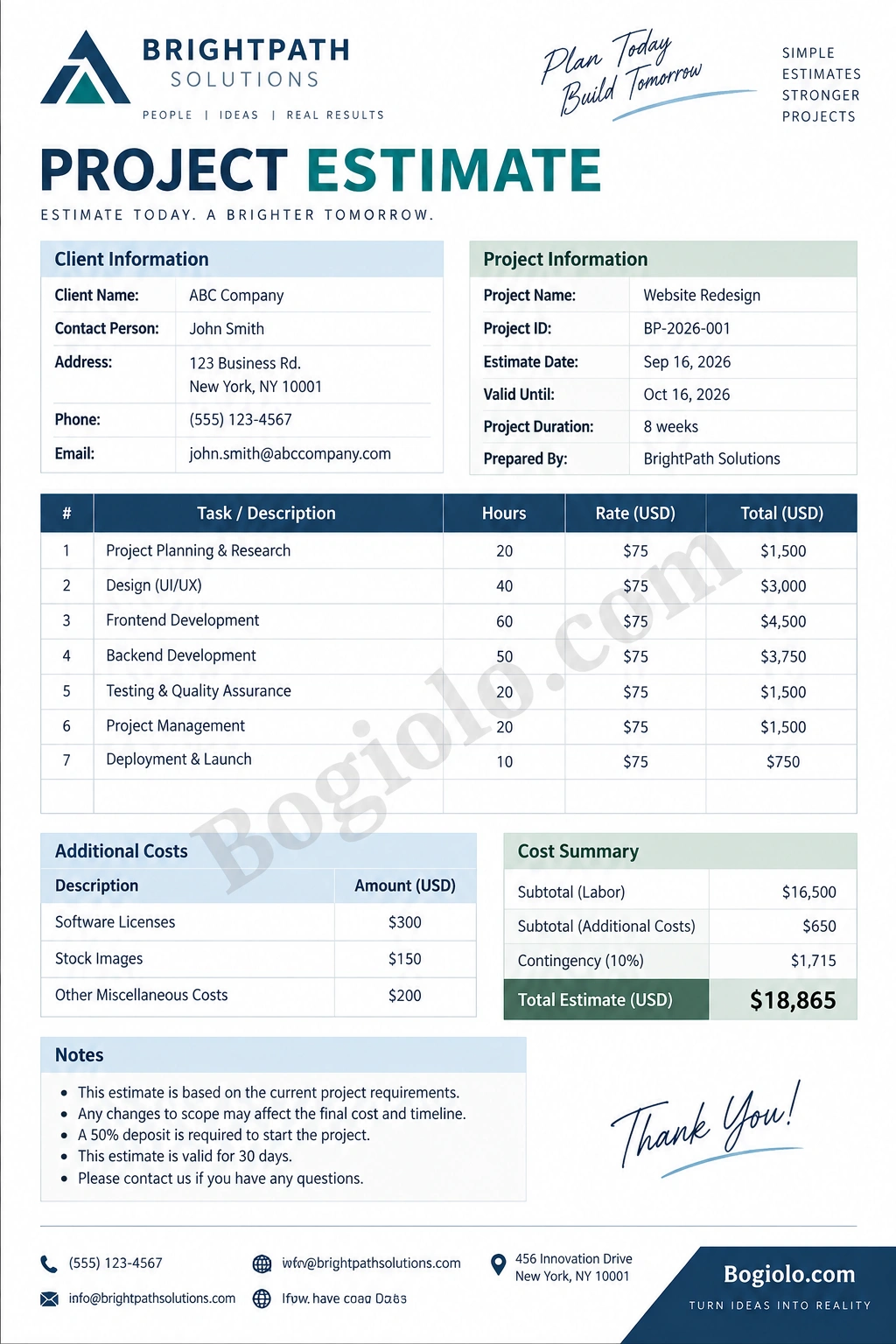
Imagine a company preparing an estimate for a website redesign. The project may include planning, UI/UX design, frontend development, backend development, testing, project management, and deployment.
Each task can be assigned an estimated number of hours and an hourly rate. The resulting labor costs can then be combined with expenses such as software licenses, stock images, hosting, or other project-specific costs.
If the estimated labor cost is $16,500 and additional expenses total $650, the subtotal would be $17,150. If a 10% contingency of $1,715 is included, the projected total estimate would be $18,865.
This type of breakdown makes it easier for the client to understand where the estimated project cost comes from rather than seeing only one unexplained total.
When Should a Project Estimate Be Updated?
A project estimate should be reviewed whenever information changes enough to affect the expected cost, timeline, or resource requirements. Examples include a major scope change, additional deliverables, unexpected technical requirements, material price changes, staffing changes, or significant schedule delays.
Maintaining an updated estimate can help stakeholders understand the potential financial impact of changes before approving additional work.
Frequently Asked Questions About Project Estimates
What is the main purpose of a Project Estimate?
The main purpose of a Project Estimate is to forecast the time, cost, and resources required to complete a project. It provides a planning foundation for budgeting, scheduling, resource allocation, and decision-making.
What is included in a project cost estimate?
A project cost estimate may include labor, materials, equipment, subcontractors, software, travel, other direct expenses, contingency, and the projected total cost.
How accurate should a project estimate be?
The appropriate level of accuracy depends on the project’s stage and the amount of information available. Early estimates may contain greater uncertainty, while estimates prepared after the scope and requirements are clearly defined can generally be more detailed.
Can a project estimate change?
Yes. Project estimates can change when scope, requirements, resources, prices, assumptions, or other project conditions change. Updating the
