A risk assessment is an essential process for identifying potential hazards, evaluating the likelihood and severity of harm, and determining the control measures needed to reduce risks. It helps businesses, organizations, and individuals make informed decisions before accidents, injuries, or operational problems occur.
Whether you manage a workplace, organize an event, oversee a construction project, or operate a small business, understanding potential risks can help you create a safer and more organized environment. A structured assessment also helps teams identify responsibilities, prioritize corrective actions, and monitor safety improvements over time.
Using a risk assessment template makes this process easier by providing a consistent way to document hazards, evaluate risk levels, and record preventive measures. In this guide, you will learn how risk assessment works, how to complete a risk assessment form, and how to choose appropriate controls for the hazards you identify.
What Is a Risk Assessment?
A risk assessment is a systematic process used to identify hazards, analyze the risks associated with them, and decide what actions are necessary to prevent or reduce harm. It considers what could go wrong, who might be affected, how serious the consequences could be, and how likely an incident is to occur.
A hazard is something with the potential to cause harm. A risk describes the possibility of that harm occurring and the potential consequences. For example, a wet floor is a hazard, while the possibility of someone slipping and sustaining an injury is the associated risk.
Risk assessments are used in many settings, including offices, factories, construction sites, healthcare facilities, schools, warehouses, and public events. The process can also apply to project management, cybersecurity, environmental protection, and business continuity.
Why Is Risk Assessment Important?
Conducting a risk assessment helps organizations recognize potential problems before they lead to injuries, property damage, financial losses, or interruptions to normal operations.
Common benefits of a structured risk assessment include:
- Improved safety: Identifies hazards that could cause injuries or illness.
- Preventive action: Helps teams address problems before an incident occurs.
- Better decision-making: Provides a consistent basis for prioritizing risks and allocating resources.
- Clear responsibilities: Assigns actions to specific individuals or teams.
- Operational continuity: Helps reduce disruptions caused by preventable incidents.
- Documentation: Creates a record of identified risks, existing controls, and planned improvements.
- Compliance support: Helps organizations identify and address applicable safety and regulatory requirements.
A risk assessment does not eliminate every possible danger. However, it provides a practical framework for reducing foreseeable risks and reviewing whether existing precautions are sufficient.
Risk Assessment Template: What Should It Include?
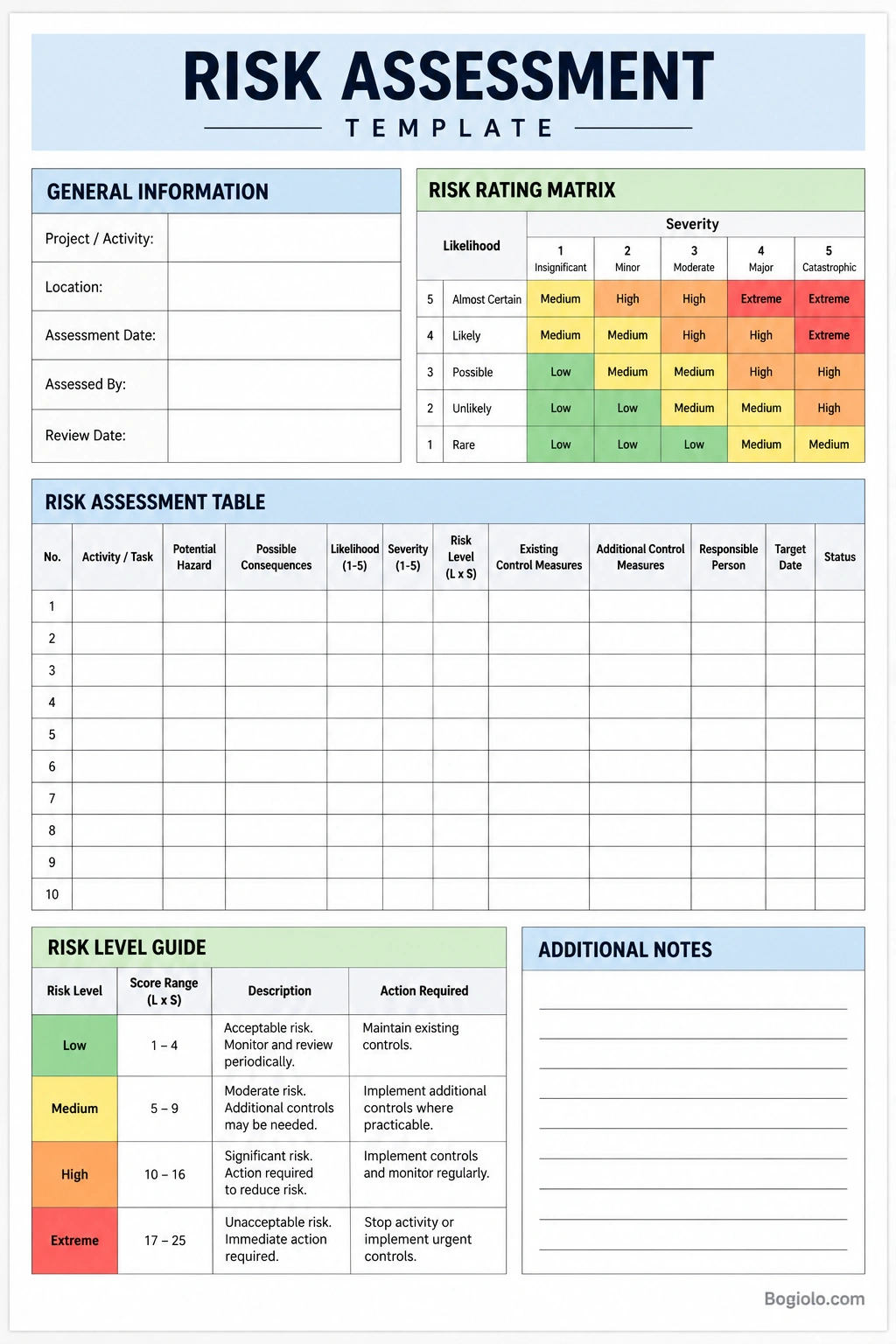
A risk assessment template helps users record important information in a consistent format. A useful form should be straightforward to complete and detailed enough to support decisions about risk reduction.
1. General Information
The first section identifies the activity, project, or workplace being assessed. Include relevant details such as the location, assessment date, assessor’s name, and planned review date.
This information helps distinguish one assessment from another and makes it easier to determine when a review is needed.
2. Hazard and Consequence Details
Record each identified hazard and explain the potential consequences. Consider who might be affected, including employees, contractors, visitors, customers, and members of the public.
For example, a poorly stored electrical cable could create a trip hazard. Potential consequences might include a fall, injury, or damage to nearby equipment.
3. Likelihood and Severity Ratings
A risk assessment matrix helps estimate how likely an incident is to occur and how serious its consequences could be. Many organizations use a numerical scale, such as 1 to 5, for both likelihood and severity.
These ratings can be combined to calculate a risk score. The scoring method and risk categories should be defined by the organization and adapted to the activity being assessed.
4. Existing and Additional Control Measures
Document the precautions already in place, such as machine guards, warning signs, staff training, ventilation, or protective equipment. Then identify any additional measures needed to reduce the remaining risk.
Each action should be specific enough to implement and verify. Avoid vague instructions such as “improve safety” when a more precise action, such as “install a guardrail along the exposed platform edge,” is appropriate.
5. Responsible Persons and Target Dates
Assign each corrective action to a responsible person or team and set a realistic completion date. Include a status field so progress can be monitored.
After the action is completed, verify that the control is effective and update the assessment if necessary.
How to Conduct a Risk Assessment Step by Step
A practical risk assessment follows a structured sequence. The exact process may vary depending on the workplace, activity, and applicable requirements, but the following steps provide a useful starting point.
Step 1: Identify Potential Hazards
Inspect the workplace or activity and look for anything that could cause harm. Consider physical conditions, equipment, substances, work practices, environmental factors, and human factors.
Useful sources of information include workplace inspections, incident reports, employee feedback, equipment manuals, safety data sheets, and previous assessments.
Common examples include:
- Slippery floors and obstructed walkways.
- Unguarded machinery or moving equipment.
- Exposed electrical components.
- Hazardous chemicals or inadequate ventilation.
- Manual handling and repetitive movements.
- Excessive noise, heat, or inadequate lighting.
- Work-related stress, fatigue, or poorly designed procedures.
Step 2: Determine Who Could Be Harmed
Identify the people who could be exposed to each hazard and consider how they might be affected. Some individuals may face greater risks because of their tasks, experience, training, or specific circumstances.
For example, a blocked emergency exit may affect everyone in a building, while an unguarded machine may present a more immediate risk to the employees operating it.
Step 3: Evaluate Likelihood and Severity
Estimate how likely an incident is to occur and how serious the resulting harm could be. Use available evidence, previous incidents, exposure levels, and the effectiveness of existing controls to inform the assessment.
A simple numerical approach multiplies the likelihood rating by the severity rating to produce a risk score. For example, a likelihood rating of 3 and a severity rating of 4 produce a score of 12.
Numerical scores are aids to decision-making, not precise predictions. Define what each rating means, establish action thresholds, and use professional judgment when a potentially severe hazard requires urgent attention.
Step 4: Select Appropriate Control Measures
Choose controls that eliminate the hazard where reasonably practicable or reduce the risk to an acceptable level. A widely used approach is the hierarchy of controls, which prioritizes more effective measures over reliance on personal protective equipment alone.
- Elimination: Remove the hazard entirely.
- Substitution: Replace the hazardous material, process, or equipment with a safer alternative.
- Engineering controls: Isolate people from hazards through guards, barriers, ventilation, or other physical measures.
- Administrative controls: Use procedures, training, scheduling, signs, and supervision to reduce exposure.
- Personal protective equipment: Provide suitable equipment, such as gloves, safety glasses, or hearing protection, when needed.
Where possible, combine complementary controls. For example, machine guarding may be supported by maintenance procedures, operator training, and appropriate protective equipment.
Step 5: Record Findings and Assign Actions
Document the hazards, people affected, risk ratings, existing controls, additional actions, responsible persons, and target dates. A written record helps everyone understand what needs to happen and why.
For significant hazards, make sure urgent controls are implemented promptly rather than waiting for the assessment paperwork to be completed.
Step 6: Review and Update the Assessment
Risk assessment is an ongoing process. Review the assessment when working conditions change, new equipment is introduced, an incident occurs, or existing controls are found to be ineffective.
Regular reviews also help verify that corrective actions have been completed and that the remaining risk is acceptable under the organization’s criteria.
How to Use a Risk Assessment Matrix
A risk assessment matrix compares likelihood and severity to help categorize risks. A common approach uses a five-point scale for each dimension, although some organizations use different scales.
- Likelihood: Rates how probable an incident is under the conditions being assessed.
- Severity: Rates the potential consequences if the incident occurs.
- Risk score: Combines the ratings according to the chosen method.
- Risk category: Classifies the result, for example as low, medium, high, or extreme.
For illustration, an organization might classify a score of 2 as low, 8 as medium, and 20 as extreme. These examples are not universal thresholds. Each organization should define its own scoring rules and required actions based on the hazards, relevant standards, and level of risk tolerance.
After applying controls, reassess the remaining risk. This is often called residual risk. A low score should not automatically override a legal requirement or a need to address a serious hazard.
Common Risk Assessment Mistakes to Avoid
A risk assessment is most useful when it reflects actual working conditions and leads to practical action. Avoid these common mistakes:
- Overlooking everyday hazards: Routine activities can still expose people to significant risks.
- Using vague descriptions: Clearly describe the hazard and the possible harm.
- Ignoring existing controls: Assess how well current precautions work rather than simply assuming they are effective.
- Relying only on scores: Use the matrix alongside evidence, experience, and professional judgment.
- Failing to assign responsibility: Every planned action should have a clear owner and target date.
- Leaving the assessment unchanged: Update the document when circumstances or controls change.
- Confusing documentation with compliance: Completing a form does not by itself ensure that legal duties have been met.
Frequently Asked Questions About Risk Assessment
What is the main purpose of a risk assessment?
The main purpose is to identify hazards, evaluate the risks they create, and determine suitable controls to prevent or reduce harm. It supports safer decisions and helps organizations manage potential problems systematically.
Who should conduct a risk assessment?
The assessment should be conducted by someone with appropriate knowledge of the activity and its hazards. Depending on the complexity and severity of the risks, input from supervisors, employees, safety professionals, engineers, or other specialists may be necessary.
How often should a risk assessment be reviewed?
Review frequency depends on the activity, workplace, applicable requirements, and level of risk. Assessments should also be reviewed when there are significant changes, incidents, new hazards, or indications that controls are no longer effective.
What is the difference between a hazard and a risk?
A hazard is something that has the potential to cause harm. A risk considers the likelihood of that harm occurring and the severity of its consequences. A wet floor is a hazard; the possibility of a person slipping and being injured is the associated risk.
What is a risk assessment matrix?
A risk assessment matrix is a tool that compares likelihood and severity to categorize risks. It helps teams prioritize actions, but the scoring method and thresholds should be defined for the specific organization and activity.
Is a risk assessment template a legal requirement?
Requirements vary by jurisdiction, industry, and type of activity. Some regulations require specific assessments or written records, while others prescribe different documentation. Check the rules applicable to your workplace rather than assuming that a general template meets every requirement.
What is residual risk?
Residual risk is the risk that remains after control measures have been implemented. It should be reassessed to determine whether further action is necessary and whether the remaining risk meets the organization’s acceptance criteria and applicable requirements.
Can I use a risk assessment template for any project?
A general template can provide a useful starting point for many activities, but it may need to be adapted. High-risk work, specialized industries, and regulated activities may require additional technical detail, specialist input, or specific documentation.
Conclusion
A risk assessment helps identify hazards, evaluate potential harm, and determine practical control measures before incidents occur. By following a structured process, organizations can make better decisions, clarify responsibilities, and monitor safety improvements.
A printable risk assessment template makes it easier to record hazards, rate likelihood and severity, assign corrective actions, and review progress. However, the form should always reflect the actual activity and applicable requirements.
Start by identifying the hazards, consider who could be affected, select effective controls, and review the results regularly. A well-maintained risk assessment can become a valuable part of a safer and more resilient workplace.
Download: Risk Assessment Template
