Paralegals play an important role in the legal profession by helping attorneys manage cases, prepare legal documents, conduct research, and organize essential information. They are trained legal professionals who perform substantive legal and organizational work under the supervision of a licensed attorney. Their contributions help law firms and legal departments operate more efficiently while allowing attorneys to focus on legal strategy and representation.
Understanding paralegal roles and responsibilities is important for both employers and individuals considering a career in the legal field. Employers need to understand the tasks paralegals can perform, while job seekers need to know the skills, qualifications, and professional expectations associated with the position.
Although daily duties vary depending on the employer and area of law, most paralegals provide support through legal research, document preparation, case management, litigation assistance, and client communication under attorney supervision.
This guide explains what paralegals do, their primary responsibilities, essential skills, educational requirements, and the differences between paralegals and other legal professionals.
What Is a Paralegal?
A paralegal is a trained legal professional who assists licensed attorneys with substantive legal work and administrative responsibilities. Paralegals work in law firms, corporate legal departments, government agencies, nonprofit organizations, and other legal environments.
Unlike general administrative assistants, paralegals perform specialized tasks that require knowledge of legal terminology, research methods, court procedures, and document preparation. Their work supports attorneys throughout different stages of legal matters, from initial case preparation to document filing and trial support.
However, paralegals are not licensed attorneys. They generally cannot independently provide legal advice, represent clients in court, or perform other activities reserved for licensed lawyers. Their legal work must remain within applicable laws, professional rules, and attorney supervision requirements.
What Are the Main Paralegal Roles and Responsibilities?
The specific paralegal roles and responsibilities depend on the type of legal practice, the employer, and the complexity of each case. However, most positions involve several common areas of work.
1. Conducting Legal Research
Legal research is one of the most important responsibilities of a paralegal. Attorneys often need accurate legal information to evaluate cases, prepare arguments, and make informed decisions.
Paralegals assist by locating relevant legal materials and organizing research findings for attorney review.
Typical legal research duties include:
- Searching statutes, regulations, and court rules.
- Finding relevant case law and legal precedents.
- Reviewing legal publications and authoritative sources.
- Researching background information related to a case.
- Preparing research summaries and organizing supporting materials.
- Checking citations and verifying legal references.
2. Preparing and Reviewing Legal Documents
Paralegals frequently prepare, organize, and review legal documents under attorney supervision. Accuracy is essential because errors in legal paperwork can cause delays, confusion, or other complications.
Common documents handled by paralegals include:
- Contracts and agreements.
- Legal correspondence and client letters.
- Pleadings and court documents.
- Discovery requests and responses.
- Affidavits and supporting documentation.
- Legal memoranda and case summaries.
Attorneys remain responsible for reviewing and approving legal documents that require their professional judgment or signature.
3. Managing Case Files and Legal Records
Organizing case information is another essential part of a paralegal’s job. Legal matters can involve large volumes of documents, communications, evidence, and deadlines. Proper file management helps attorneys access important information when they need it.
Typical case management responsibilities include:
- Creating and maintaining physical and electronic case files.
- Organizing contracts, correspondence, and supporting evidence.
- Updating case management databases.
- Tracking important dates and filing deadlines.
- Maintaining document versions and records.
- Preparing case materials for attorney review.
4. Supporting Litigation and Trial Preparation
Paralegals provide valuable assistance during litigation. They help attorneys prepare cases by organizing evidence, reviewing documents, coordinating schedules, and preparing trial materials.
Litigation support duties may include:
- Organizing discovery documents and evidence.
- Preparing deposition materials.
- Creating exhibit lists and trial binders.
- Coordinating court filing deadlines.
- Assisting with witness and deposition scheduling.
- Preparing documents and materials for hearings and trials.
These responsibilities help attorneys manage the procedural and organizational aspects of litigation more efficiently.
5. Communicating With Clients and Other Parties
Paralegals may communicate with clients, court personnel, opposing counsel, and other third parties as authorized by supervising attorneys.
Communication-related responsibilities can include:
- Scheduling meetings and appointments.
- Requesting documents and relevant information from clients.
- Providing approved case status updates.
- Coordinating communications between legal teams.
- Preparing routine correspondence for attorney review.
- Recording important communications in case files.
Paralegals must understand the boundaries of their role and avoid independently providing legal advice or making unauthorized legal commitments.
6. Assisting With Discovery and Evidence Organization
During litigation, attorneys may need to review extensive amounts of information exchanged between parties. Paralegals help organize this material and support the discovery process.
Common duties include reviewing documents, organizing electronic records, maintaining evidence inventories, identifying relevant materials, and preparing information for attorney review.
7. Monitoring Deadlines and Court Schedules
Legal cases often involve strict deadlines and procedural requirements. Paralegals help attorneys stay organized by maintaining calendars and tracking important dates.
These tasks may include monitoring filing deadlines, scheduling hearings, coordinating depositions, and reminding legal teams about upcoming obligations.
8. Performing Administrative and Organizational Tasks
In addition to substantive legal work, paralegals handle administrative duties that support daily legal operations.
Examples include maintaining records, organizing meetings, preparing expense documentation, processing authorized filings, and coordinating document delivery.
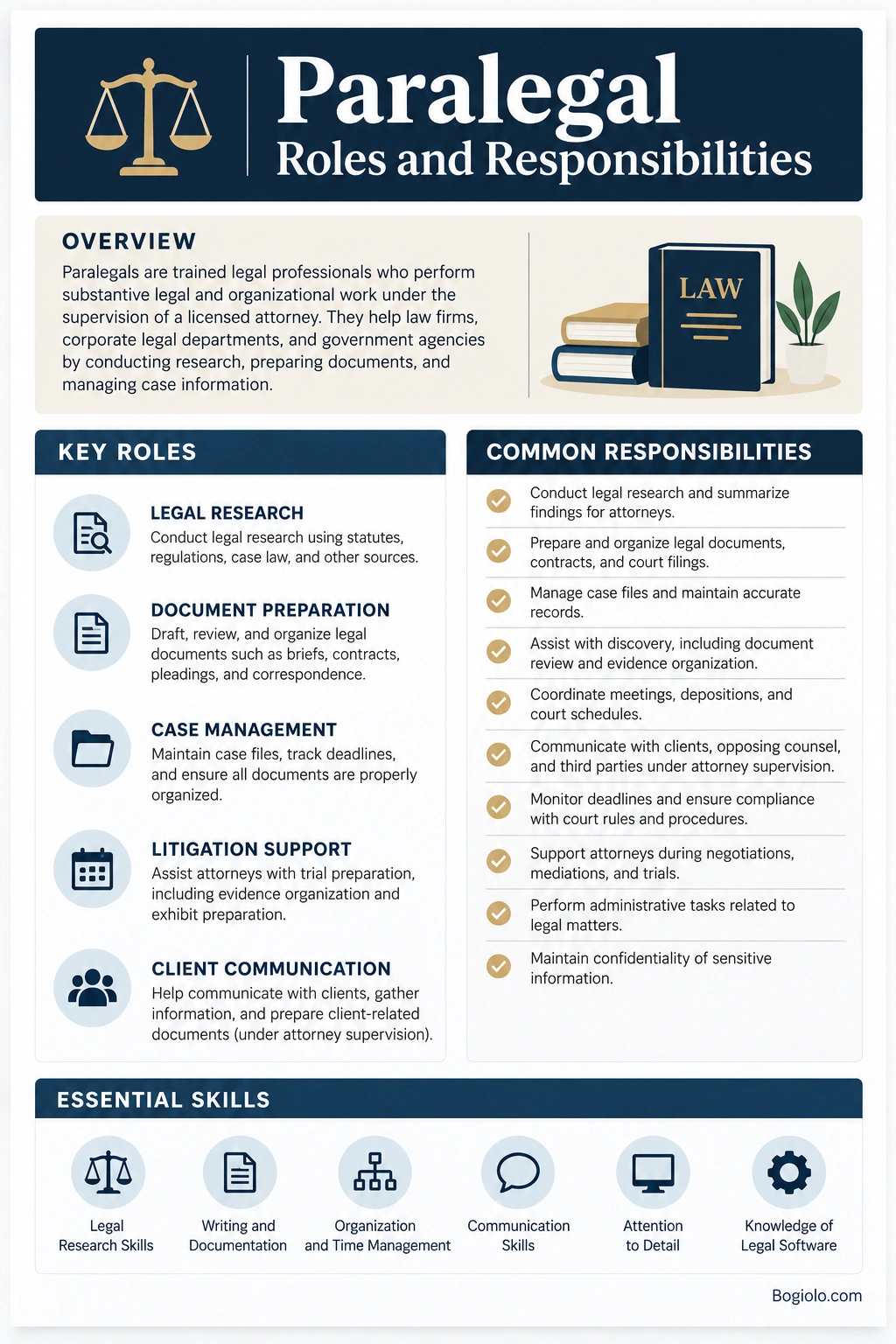
Paralegal Roles and Responsibilities by Practice Area
Paralegal duties can differ significantly depending on the area of law. Each specialty involves different documents, procedures, research requirements, and case management activities.
1. Litigation Paralegal
Litigation paralegals assist attorneys with civil and commercial disputes. Their work often includes preparing court documents, organizing discovery materials, tracking deadlines, and supporting trial preparation.
2. Corporate Paralegal
Corporate paralegals support business legal matters, including company formation, corporate governance, contract management, and regulatory documentation.
3. Family Law Paralegal
Family law paralegals assist with matters involving divorce, child custody, adoption, and other family-related legal issues. They may organize financial records, prepare case documents, and coordinate appointments.
4. Real Estate Paralegal
Real estate paralegals support property transactions and related legal matters. Their responsibilities may include reviewing property records, organizing closing documents, preparing transaction files, and coordinating with relevant parties.
5. Immigration Paralegal
Immigration paralegals assist attorneys with immigration-related cases by organizing application materials, collecting supporting documents, tracking filing deadlines, and maintaining client records.
6. Personal Injury Paralegal
Personal injury paralegals help attorneys organize accident records, medical documentation, insurance correspondence, evidence, and settlement-related materials.
Essential Skills Every Paralegal Should Have
Successful paralegals need a combination of technical legal knowledge, communication abilities, and organizational skills. These competencies help them manage detailed work accurately and support attorneys effectively.
1. Legal Research Skills
Paralegals should know how to locate relevant statutes, regulations, case law, and legal information using reliable research sources.
2. Writing and Documentation Skills
Strong writing skills are important for preparing correspondence, organizing legal information, drafting documents for attorney review, and creating clear research summaries.
3. Attention to Detail
Legal work requires accuracy. Paralegals must carefully review names, dates, citations, document references, and filing requirements to minimize mistakes.
4. Communication Skills
Clear verbal and written communication helps paralegals interact professionally with attorneys, clients, court personnel, and other parties.
5. Organization and Time Management
Paralegals often handle multiple cases and competing deadlines. The ability to prioritize tasks, maintain records, and manage schedules is essential.
6. Confidentiality and Professional Ethics
Paralegals regularly handle sensitive client information. They must protect confidential records, follow applicable professional conduct requirements, and understand their ethical responsibilities.
7. Legal Technology Proficiency
Modern legal workplaces rely on digital tools for research, document preparation, case management, electronic filing, and document review. Familiarity with relevant software can improve efficiency and accuracy.
Education and Qualifications for Becoming a Paralegal
Educational requirements vary by employer and jurisdiction. In the United States, many employers prefer candidates who have completed formal paralegal education or have relevant legal work experience.
Common educational pathways include:
- Associate degree: An associate degree in paralegal studies or a related field provides foundational legal knowledge and practical training.
- Bachelor’s degree: Some employers prefer candidates with a bachelor’s degree, particularly for specialized or more advanced positions.
- Paralegal certificate: Certificate programs can provide focused training for individuals who already hold a degree or have experience in another field.
- Relevant work experience: Previous experience in a law office, legal department, or administrative legal role may strengthen an applicant’s qualifications.
- Professional certification: Voluntary credentials from recognized professional organizations may demonstrate additional knowledge and professional commitment.
It is important to check the specific requirements of employers and applicable state rules because paralegal education, certification, and professional standards can vary.
Paralegal vs. Legal Assistant: What Is the Difference?
The terms paralegal and legal assistant are sometimes used interchangeably, but their meanings can differ depending on the employer and workplace.
Paralegal
A paralegal generally performs substantive legal work under attorney supervision. Responsibilities may include legal research, document preparation, discovery assistance, and case management.
Legal Assistant
A legal assistant may focus more heavily on administrative and organizational support, such as scheduling appointments, answering routine inquiries, maintaining records, and managing correspondence.
However, some organizations use the same title for positions involving both administrative and substantive legal responsibilities. Job seekers should review the actual duties rather than relying only on the job title.
What Paralegals Cannot Do
Although paralegals perform important legal work, they must operate within the limits of their professional role. They are not licensed attorneys and cannot independently perform activities that constitute the unauthorized practice of law.
Generally, paralegals cannot:
- Provide independent legal advice to clients.
- Represent clients in court unless specifically authorized by applicable law or rules.
- Establish an attorney-client relationship independently.
- Settle legal claims or make binding legal decisions on behalf of clients without proper authority.
- Sign documents that require an attorney’s signature or professional authorization.
- Independently determine legal strategy for a client’s case.
Specific rules may vary by jurisdiction and type of legal proceeding. Attorneys remain responsible for supervising delegated work and ensuring that paralegals comply with applicable professional requirements.
How Employers Can Define Paralegal Responsibilities
Employers should establish clear expectations when creating a paralegal job profile or hiring for a legal support position. A well-defined role helps attract qualified candidates and supports effective workplace management.
Consider including the following information in a paralegal job profile:
- Job title: Paralegal, Litigation Paralegal, Corporate Paralegal, or another relevant title.
- Department: The legal department or practice area where the position is assigned.
- Reporting structure: The supervising attorney or legal manager.
- Job summary: A brief explanation of the position’s purpose.
- Key responsibilities: The substantive legal and administrative duties expected.
- Qualifications: Required education, experience, and relevant credentials.
- Essential skills: Research, writing, organization, communication, and technology proficiency.
- Working conditions: Employment type, work location, schedule, and other relevant requirements.
Clearly distinguishing between essential and preferred qualifications can also help employers reach a wider pool of suitable applicants.
Frequently Asked Questions About Paralegal Roles and Responsibilities
What are the main responsibilities of a paralegal?
The main responsibilities of a paralegal include conducting legal research, preparing documents, managing case files, assisting with discovery, supporting litigation, tracking deadlines, and communicating with clients under attorney supervision.
Do paralegals need a law degree?
No. Paralegals generally do not need a law degree. Many enter the profession through an associate degree, bachelor’s degree, paralegal certificate program, or relevant legal work experience. Requirements vary by employer and jurisdiction.
Can paralegals give legal advice?
Generally, no. Paralegals cannot independently provide legal advice because they are not licensed attorneys. They must work under appropriate attorney supervision and follow applicable rules governing the unauthorized practice of law.
Where do paralegals usually work?
Paralegals commonly work in private law firms, corporate legal departments, government agencies, nonprofit organizations, and other institutions that require legal support services.
What skills are most important for a paralegal?
Important paralegal skills include legal research, writing, attention to detail, communication, organization, time management, confidentiality, and proficiency with legal technology.
What is the difference between a paralegal and an attorney?
An attorney is a licensed legal professional who can provide legal advice and represent clients within the scope of their license. A paralegal assists attorneys with substantive legal and organizational work but generally cannot independently perform activities reserved for licensed lawyers.
Can paralegals work independently?
Paralegals can independently manage assigned tasks and organize their daily workload. However, substantive legal work must remain within the scope of authorized duties and appropriate attorney supervision.
Are paralegals responsible for preparing court documents?
Yes. Paralegals commonly prepare, organize, and review court documents for attorney approval. Attorneys generally retain responsibility for legal decisions, final review, and documents requiring their professional signature.
What are the different types of paralegals?
Common specialties include litigation, corporate, family law, immigration, real estate, criminal law, estate planning, and personal injury paralegals. Each specialty involves different legal procedures and responsibilities.
Is paralegal a good career choice?
Paralegal work may be a suitable career for individuals who enjoy legal research, writing, organization, problem-solving, and supporting legal professionals. Career opportunities depend on education, experience, location, and employer requirements.
Conclusion
Paralegal roles and responsibilities cover a wide range of legal and organizational activities that help attorneys manage their cases and serve their clients effectively. From conducting legal research and preparing documents to managing case files and supporting litigation, paralegals contribute significantly to the daily operations of legal organizations.
To succeed in this profession, individuals need strong research, communication, writing, organizational, and technical skills. They must also understand confidentiality requirements, professional ethics, and the boundaries of working under attorney supervision.
For employers, defining paralegal responsibilities clearly is essential for effective recruitment and workforce planning. For job seekers, understanding these duties provides a practical starting point for evaluating qualifications and building a successful career in the legal field.
Download: Paralegal Roles and Responsibilities Template
