A request for quote is an important business document used to obtain pricing information from potential suppliers for specific goods or services. It helps businesses compare vendor offers, evaluate costs, and select a supplier based on price, quality, delivery time, and other requirements. A clear request for quote also makes the purchasing process more organized and transparent.
Whether you are purchasing office supplies, sourcing manufacturing materials, hiring a service provider, or managing a large procurement project, requesting quotes can help you make informed purchasing decisions. By sending the same requirements to multiple suppliers, you can compare their responses using consistent criteria rather than relying on estimates or incomplete information.
A well-prepared request for quote template saves time because it provides a structured format for describing requirements, quantities, specifications, deadlines, and submission instructions. In this guide, you will learn what an RFQ is, what information it should include, how to prepare one, and how to compare supplier quotations effectively.
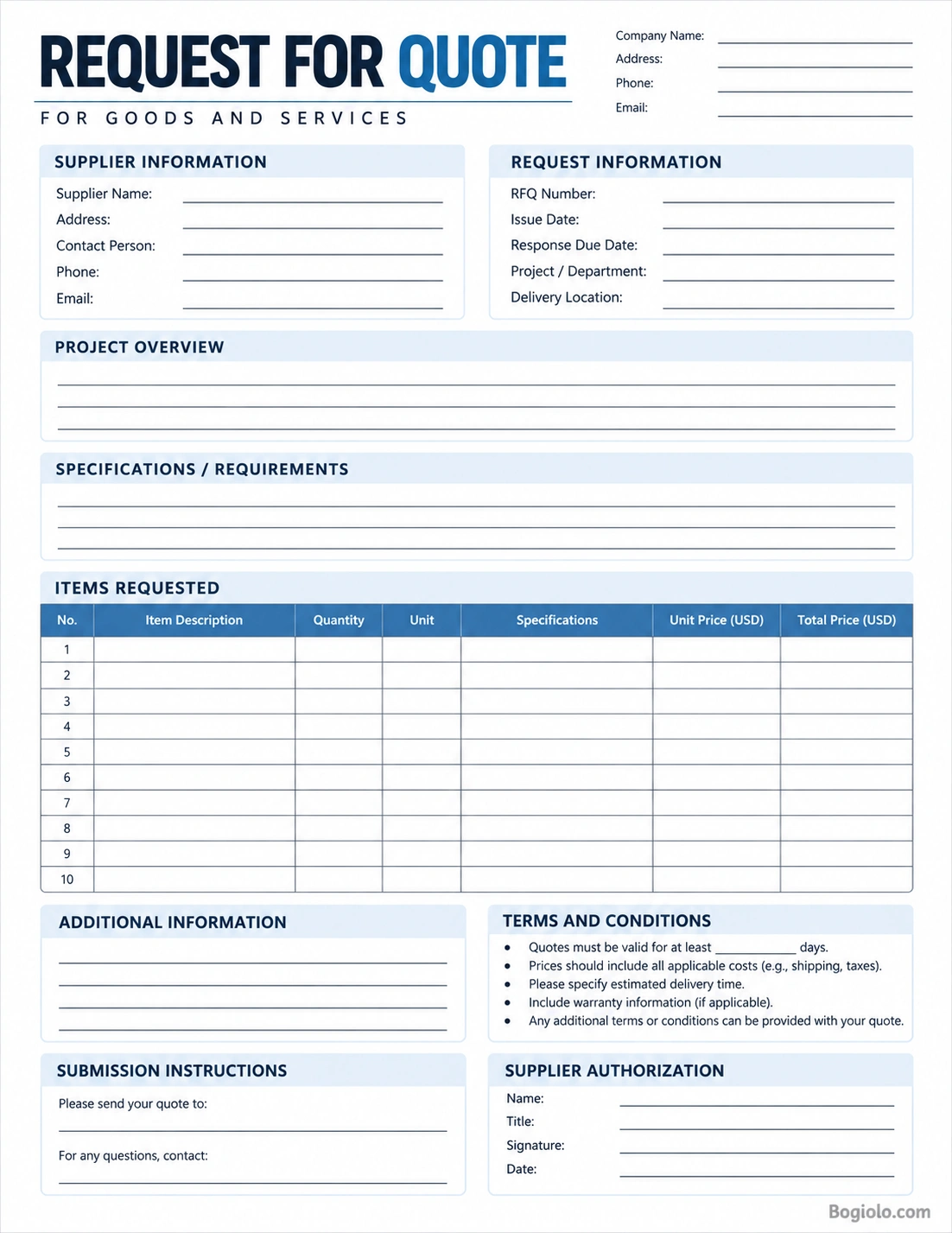
What Is a Request for Quote?
A request for quote, commonly abbreviated as RFQ, is a formal document that invites suppliers to submit prices for clearly defined products or services. The requesting business specifies what it needs, how much it needs, and the conditions suppliers must meet when preparing their quotations.
An RFQ is particularly useful when the buyer already understands the required specifications and wants to compare supplier pricing on a consistent basis. For example, a company purchasing 500 identical office chairs can send the same quantity, material requirements, delivery location, and deadline to several vendors.
Suppliers then respond with quotations that may include unit prices, total costs, shipping charges, taxes, delivery estimates, payment terms, and quote validity periods.
A request for quote is commonly used for:
- Office and business supplies: Obtain pricing for furniture, equipment, stationery, and other recurring purchases.
- Manufacturing materials: Compare costs for raw materials, components, and production supplies.
- Construction projects: Request prices for specified materials, equipment, or clearly defined work packages.
- Professional services: Compare fees for services with established scopes and deliverables.
- Technology purchases: Request quotations for computers, software licenses, networking equipment, and related services.
Why Businesses Use a Request for Quote
A structured RFQ helps businesses make purchasing decisions based on comparable information. It can also improve communication between buyers and suppliers by establishing clear expectations from the beginning.
Compare Supplier Prices Fairly
When every supplier receives the same specifications, the resulting quotations are easier to compare. Buyers can review unit prices, total costs, delivery charges, and other commercial terms without spending excessive time clarifying different assumptions.
Improve Budget Planning
Supplier quotations provide a clearer picture of expected purchasing costs. Businesses can use this information to estimate project budgets, assess affordability, and identify potential cost differences before committing to a purchase.
Increase Procurement Transparency
A documented RFQ process creates a record of the requirements communicated to suppliers and the offers received. This can support internal reviews, purchasing approvals, and accountability. Organizations should also follow any applicable procurement policies and competition requirements.
Reduce Misunderstandings
Incomplete specifications can lead to quotations that are difficult to compare or orders that do not meet expectations. A detailed request for quote explains the required products or services, quantities, quality standards, delivery arrangements, and submission deadline.
Support Better Supplier Selection
The lowest price is not always the best choice. An RFQ allows a business to consider other important factors, such as product quality, availability, delivery reliability, warranty coverage, and payment terms.
What to Include in a Request for Quote Template
A useful request for quote template organizes the information suppliers need to prepare accurate offers. The exact fields depend on the purchase, but most RFQs include the following sections.
Buyer and Supplier Information
Identify the purchasing company, department, contact person, and communication details. Include the supplier’s name and contact information when sending the document to a specific vendor. For an open invitation, explain how interested suppliers should direct their questions.
RFQ Number and Important Dates
Assign a reference number to help track the request and related correspondence. Record the issue date, question deadline, quotation submission deadline, and expected decision date when known. A consistent reference number is especially useful when managing several procurement projects.
Product or Service Specifications
Describe exactly what you want to purchase. Include relevant product names, model numbers, materials, dimensions, performance standards, service scope, or other measurable requirements. Clear specifications help suppliers quote comparable products and services.
Quantity and Pricing Details
List the quantity required and the appropriate unit of measurement. Ask suppliers to provide unit prices and extended totals. If relevant, request separate amounts for shipping, installation, taxes, or optional services so you can calculate the overall cost.
Delivery and Schedule Requirements
Specify the delivery address, preferred delivery date, or required completion period. For service contracts, include the expected start date, milestones, and completion requirements. Ask suppliers to identify any limitations or scheduling conditions in their quotations.
Terms and Conditions
State the commercial terms that suppliers need to understand before submitting an offer. These may include payment terms, quote validity, warranty expectations, required documentation, and applicable contractual conditions. Make sure the terms are clear and appropriate for the purchase.
Submission Instructions
Explain how suppliers should submit their quotations, which documents they must include, and whom they should contact with questions. Specify the deadline and preferred file format or submission channel. For formal procurement exercises, provide any required evaluation or compliance instructions.
How to Write an Effective Request for Quote
Preparing an RFQ becomes easier when you follow a consistent process. These steps help ensure that suppliers understand your requirements and can respond accurately.
Define Your Purchasing Requirements
Start by identifying the products or services you need, the quantities involved, and the standards the supplier must meet. Consult relevant departments to confirm technical requirements, budget constraints, and delivery expectations before contacting vendors.
Prepare Clear Specifications
Use precise descriptions instead of broad statements. For example, rather than requesting “office chairs,” specify the required quantity, chair type, material, adjustable features, color, and any relevant quality or safety standards. For services, describe the scope, deliverables, and expected outcomes.
Identify Suitable Suppliers
Choose vendors that have the capability to meet your requirements. Consider their relevant experience, product availability, service coverage, and ability to meet the required schedule. Depending on your procurement policy, you may need to invite a minimum number of suppliers or follow a formal sourcing process.
Set a Reasonable Response Deadline
Give suppliers enough time to review the specifications, confirm availability, and calculate their prices. Complex requirements may need a longer response period than routine purchases. Include a deadline for clarification questions if the procurement process requires one.
Send the Same Requirements to Every Supplier
For a fair comparison, provide invited suppliers with the same specifications, quantities, deadlines, and commercial requirements. If you issue an important clarification or change, communicate it consistently to all affected suppliers.
Review and Compare the Responses
Once quotations arrive, check whether each supplier has answered every required item. Compare total costs, delivery commitments, quality requirements, warranties, and payment terms. Request clarification when information is missing, following your procurement rules.
How to Compare Supplier Quotations
Comparing quotations requires more than sorting offers from lowest to highest price. A structured evaluation helps reveal differences that may affect the actual value of each offer.
Calculate the Total Cost
Review unit prices, quantities, shipping, installation, taxes, and other applicable charges. Make sure you compare quotations using the same assumptions. A supplier with a lower unit price may have a higher final cost because of additional fees or delivery expenses.
Check Compliance With Specifications
Confirm that each offer meets the required product specifications, service scope, quality standards, and delivery conditions. If a supplier proposes an alternative, record the difference and evaluate whether it is acceptable under your procurement rules.
Evaluate Delivery and Reliability
Consider whether the supplier can meet your schedule and provide the required quantities. Delayed delivery can create additional costs or disrupt operations, even when the quoted price is attractive.
Review Commercial Terms
Examine payment schedules, warranty coverage, quote validity, return policies, and other relevant conditions. These terms may affect the overall value and risk of the purchase.
Document the Decision
Keep a record of the quotations received, the evaluation criteria, any clarifications, and the reasons for selecting a supplier. This documentation can support purchasing approvals and future supplier reviews.
Request for Quote vs. Request for Proposal
A request for quote and a request for proposal serve different procurement needs. Choosing the right document depends on how clearly the requirements are defined and how much the buyer expects suppliers to develop their own solutions.
- Request for quote (RFQ): Best when the buyer has defined the required goods or services and wants comparable pricing.
- Request for proposal (RFP): Best when the buyer wants suppliers to propose approaches, solutions, methodologies, or service plans for a broader business need.
- Request for information (RFI): Best for gathering preliminary information about supplier capabilities, available products, or potential market solutions before a formal purchasing decision.
These processes can overlap in practice, and organizations may use different terminology. Always follow the procurement procedures and legal requirements that apply to your industry and location.
Common Request for Quote Mistakes to Avoid
A poorly prepared RFQ can produce incomplete quotations, delays, and unexpected costs. Avoid these common problems when preparing your document.
- Vague specifications: Describe the required goods or services clearly enough for suppliers to quote accurately.
- Missing quantities: State quantities and units so suppliers can calculate comparable prices.
- Unclear deadlines: Include the quotation submission date and the expected delivery or completion schedule.
- Hidden costs: Ask suppliers to identify shipping, taxes, installation, and other applicable charges.
- Inconsistent requirements: Give all invited suppliers the same information and communicate changes consistently.
- Price-only evaluation: Consider quality, delivery, compliance, warranty, and total cost alongside the quoted price.
- Poor recordkeeping: Save quotations, clarifications, evaluations, and approval records in an organized location.
Frequently Asked Questions About Request for Quote
What does request for quote mean?
A request for quote is a formal request asking suppliers to provide prices for specified goods or services. It helps buyers compare offers using consistent requirements and commercial criteria.
What is an RFQ template used for?
An RFQ template provides a standard format for recording supplier information, product specifications, quantities, pricing, deadlines, and submission instructions. It saves preparation time and makes quotations easier to compare.
Is a request for quote legally binding?
Issuing an RFQ does not automatically mean the buyer must purchase from a supplier or accept a quotation. However, the legal effect depends on the wording, applicable law, procurement rules, and subsequent agreements. Review the relevant terms before issuing or accepting an offer.
How many suppliers should receive an RFQ?
The appropriate number depends on the purchase, market conditions, internal policy, and any applicable procurement rules. Inviting multiple qualified suppliers can improve price comparison, but some purchases may have limited supplier availability.
What is the difference between an RFQ and an RFP?
An RFQ generally requests pricing for clearly defined requirements. An RFP asks suppliers to propose solutions or approaches to a business need and may evaluate methodology, experience, service quality, and price.
How long should suppliers have to respond to an RFQ?
The response period should reflect the complexity of the requirements and the time needed to prepare an accurate quotation. Simple purchases may need only a short period, while specialized products or complex services may require more time.
What should happen after receiving quotations?
Check each quotation for completeness, compare total costs and compliance, clarify missing information, and document the evaluation. Obtain the necessary internal approvals before placing an order or entering into an agreement.
Improve Your Purchasing Process With a Request for Quote
A request for quote helps businesses obtain comparable supplier pricing, clarify purchasing requirements, and make more informed procurement decisions. By providing accurate specifications and consistent instructions, you can reduce misunderstandings and evaluate offers more efficiently.
Use a request for quote template to organize supplier details, quantities, prices, delivery requirements, and commercial terms. Review every quotation carefully and consider overall value rather than price alone. With a clear and consistent process, your business can improve purchasing transparency, manage costs, and build stronger supplier relationships“`
Download: Request for Quote Template
