A rental ledger is an essential record for tracking rent payments, outstanding balances, and other financial transactions between a landlord and a tenant. It provides a clear payment history, making it easier to monitor rent collection, identify missed payments, and maintain accurate rental records.
Whether you manage a single rental property or several units, a rental ledger template can help you organize financial information in one convenient place. Tenants can also use a rent payment ledger to review their payment history and keep records of completed transactions.
In this guide, you will learn what a rental ledger is, what information it should include, and how to maintain an accurate rent payment record. You will also find practical examples, organization tips, and answers to frequently asked questions.
What Is a Rental Ledger?
A rental ledger is a chronological record of rent payments and other rental-related financial transactions. It typically documents the rent charged, payments received, additional charges, and any outstanding balance for a particular tenancy.
Landlords use a rental payment ledger to monitor rent collection and maintain consistent financial records. Property managers may use it to review tenant accounts, reconcile payments, and prepare reports for property owners.
Tenants can also benefit from keeping a copy of their rent payment history. These records may help them verify payments, resolve discrepancies, or provide documentation when requested by a landlord or another authorized party.
A rental ledger is different from a lease agreement. The lease establishes the rental terms, while the ledger records financial activity under those terms.
Why Is a Rental Ledger Important?
Maintaining a rental ledger helps both landlords and tenants understand the financial status of a rental arrangement. Accurate records reduce confusion and make payment history easier to review.
- Track rent payments: Record when rent is due, how much is charged, and when payments are received.
- Identify outstanding balances: See whether any amount remains unpaid after applying recorded payments.
- Maintain organized records: Keep rental transactions together instead of relying on scattered notes or messages.
- Resolve payment disputes: Compare ledger entries with receipts, bank records, and other supporting documents.
- Support property management: Review rent collection across different periods and properties.
- Prepare financial summaries: Use transaction records when reviewing rental income and expenses.
A ledger is most useful when it is updated consistently and supported by reliable documentation. It should reflect actual transactions rather than assumptions about whether a payment was made.
What Information Should a Rental Ledger Include?
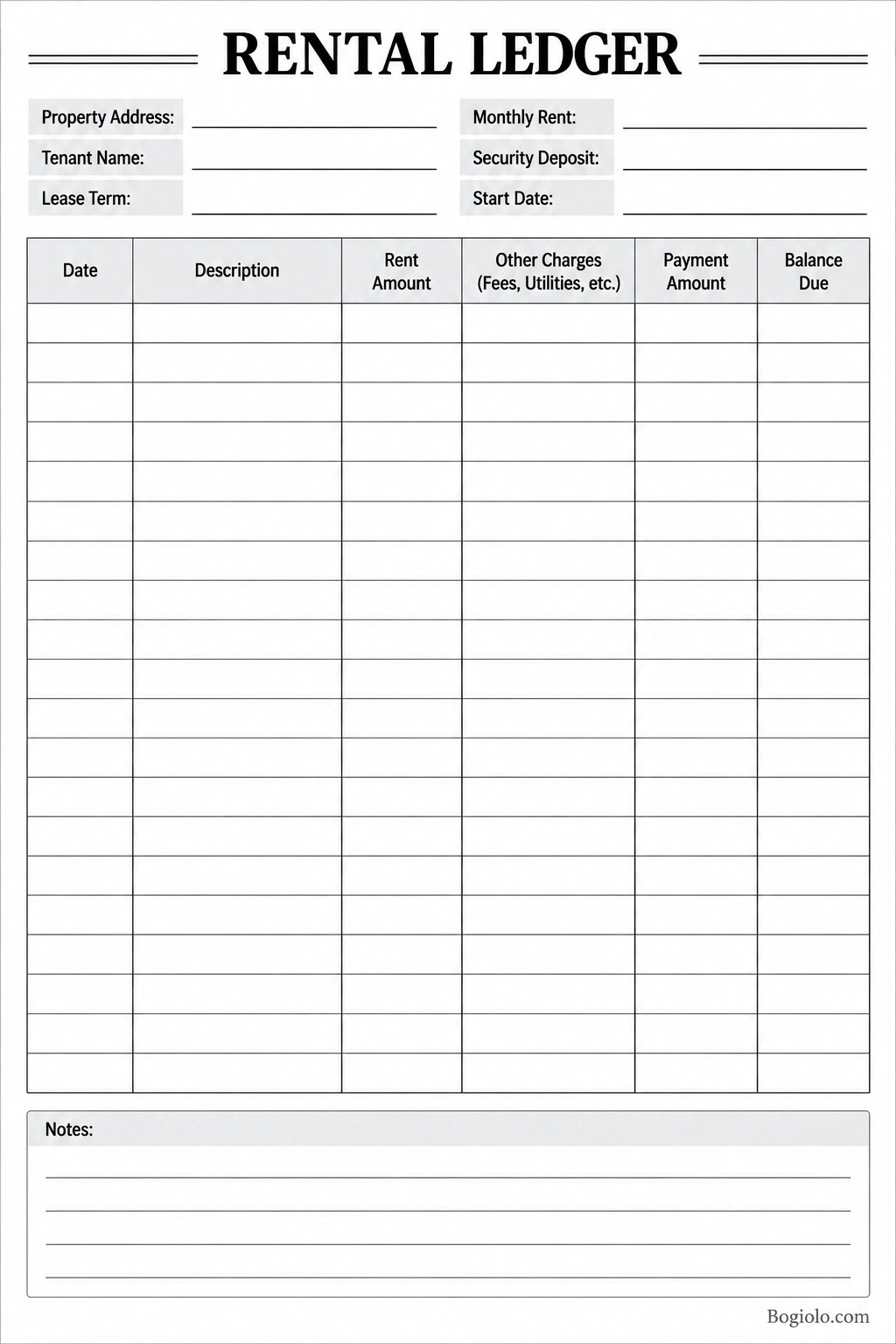
A useful rental ledger contains enough detail to identify the rental property, the tenant, each transaction, and the resulting balance. The exact layout can vary depending on the property and the landlord’s recordkeeping needs.
1. Property and Tenant Information
Begin with the basic details needed to identify the tenancy. These fields help distinguish one rental account from another, especially when a landlord manages multiple properties.
- Property address: The address of the rental unit.
- Tenant name: The tenant associated with the account.
- Lease term: The applicable rental period.
- Monthly rent: The agreed rental amount.
- Security deposit: The deposit amount, recorded separately from ordinary rent payments when appropriate.
- Lease start date: The date the tenancy begins.
Include only the personal information necessary for the record and store it securely.
2. Transaction Date
Record the date associated with each transaction. Depending on the entry, this may be the date rent was charged, the date payment was received, or the date an authorized adjustment was posted.
Using consistent dates helps maintain a clear chronological history. If the payment date differs from the rent due date, record both when the distinction is important.
3. Transaction Description
Use the description field to explain what each entry represents. Examples include monthly rent, late fee where legally permitted, utility reimbursement, maintenance charge, payment received, or account adjustment.
Descriptions should be specific enough to explain the transaction without requiring the reader to search through unrelated documents.
4. Rent and Other Charges
Record the amount of rent charged for the relevant period. If additional charges apply, list them separately and identify their purpose.
Additional charges should be consistent with the lease and applicable law. Do not automatically classify every cost as a tenant obligation without confirming that it is authorized.
5. Payment Amount
Enter the amount actually received and applied to the tenant’s account. If a tenant makes a partial payment, record the actual amount rather than marking the full rent obligation as paid.
Where necessary, include a payment reference or receipt number so the transaction can be matched to supporting records.
6. Balance Due
The balance due shows the amount remaining after charges and payments have been applied. To calculate it accurately, start with the previous balance, add new charges, and subtract payments or credits.
New balance = Previous balance + New charges − Payments and credits
Use the same calculation method throughout the ledger. If a payment is allocated to a particular charge, document that allocation according to the lease, applicable rules, and your recordkeeping procedure.
How to Use a Rental Ledger Template
A printable rental ledger makes it easier to maintain a consistent payment history. Follow these steps to create a clear record for each rental account.
Step 1: Enter the Property Details
Complete the property address, tenant name, monthly rent, lease term, and start date. Check the information against the signed lease to reduce errors.
Step 2: Record Rent Charges
Enter the rent charge for each rental period according to the lease. Record the due date or charge date consistently and identify the period covered by the rent.
If the rent changes during the tenancy, document the effective date and applicable amount. Retain the relevant notice or agreement with the rental records.
Step 3: Record Payments Promptly
Whenever payment is received, enter the amount, payment date, and relevant reference information. Keep supporting receipts or transaction confirmations when available.
For electronic payments, use the transaction details to verify the amount received. For cash payments, provide appropriate documentation and retain a record of the receipt.
Step 4: Add Other Authorized Charges or Credits
Record additional charges and credits separately from base rent. Explain the reason for each entry and retain supporting documents, such as invoices, notices, or written agreements, where appropriate.
Do not combine unrelated charges into a single unexplained amount. Separate entries make the ledger easier to review and verify.
Step 5: Update the Balance
After recording a charge, payment, or credit, recalculate the balance. Compare the result with the previous entry to ensure that no transaction has been omitted or entered twice.
Step 6: Review the Ledger Regularly
Review the rental ledger at least once each rental period and whenever a payment discrepancy arises. Compare entries with the lease, payment confirmations, receipts, and relevant account records.
Correct errors transparently and retain the supporting documentation. Avoid deleting or changing historical entries without a clear record of the correction.
Rental Ledger Example
The following fictional example shows how a basic rental payment ledger might work. All amounts are illustrative and use US dollars.
- Monthly rent charge: $1,200
- Payment received on the due date: $1,200
- Balance after payment: $0
- Next month’s rent charge: $1,200
- Partial payment received: $900
- Remaining balance after the partial payment: $300
In this example, the first month’s rent is fully paid, leaving no balance for that period. In the following month, the tenant pays $900 toward a $1,200 rent charge, leaving $300 outstanding, assuming there are no previous balances, additional charges, or credits.
The ledger should show each charge and payment as a separate transaction. This creates a transparent record of how the remaining balance was calculated.
Tips for Maintaining an Accurate Rent Payment Ledger
Consistent recordkeeping helps prevent confusion and makes it easier to review tenant accounts.
- Update records promptly: Record charges and payments as they occur.
- Use consistent categories: Separate rent, fees, other charges, payments, and credits.
- Keep supporting documents: Retain receipts, payment confirmations, lease documents, and relevant notices.
- Verify calculations: Check the balance after each transaction and during regular reviews.
- Maintain one ledger per tenancy: Avoid mixing transactions from different tenants or properties.
- Document corrections: Make adjustments traceable and explain why they were necessary.
- Protect tenant information: Limit access to authorized people and store records securely.
- Follow local requirements: Check applicable laws governing rent, fees, deposits, record retention, and tenant notices.
Printable Rental Ledger vs. Digital Spreadsheet
A printable rental ledger and a digital spreadsheet can both help organize rental payment records. The best option depends on the number of properties, the volume of transactions, and your preferred workflow.
- Printable rental ledger: Suitable for landlords who prefer handwriting entries or maintaining a physical property file.
- Digital rental ledger: Useful for searching transactions, correcting entries, calculating balances, and reviewing multiple rental periods.
- Property management software: May provide automated rent tracking, payment reminders, tenant statements, and reporting features.
A printable rent ledger may be sufficient for a single property with straightforward transactions. Landlords managing several units may benefit from a digital system with secure backups and consistent reporting.
Frequently Asked Questions About Rental Ledgers
What is a rental ledger used for?
A rental ledger records rent charges, payments received, other authorized charges, credits, and outstanding balances. It helps landlords and tenants review the financial history of a tenancy.
What is the difference between a rental ledger and a rent receipt?
A rent receipt documents an individual payment, while a rental ledger provides a chronological record of multiple charges and payments over time. Receipts can serve as supporting documents for entries in the ledger.
Can a tenant request a rental ledger?
A tenant can ask the landlord or property manager for a copy of their payment history. Whether the landlord must provide it, and within what timeframe, depends on applicable local law and the circumstances.
How often should a rental ledger be updated?
Update the ledger whenever a rent charge, payment, credit, or other authorized transaction occurs. Regular updates make it easier to identify discrepancies before they become more difficult to resolve.
Can I use a rental ledger template for multiple properties?
Yes, but maintain a separate ledger or clearly separated account for each property and tenancy. This prevents transactions from being mixed and makes individual rental histories easier to review.
Should security deposits appear in a rental ledger?
A security deposit can be documented in the rental records, but it should be clearly identified and kept separate from ordinary rent charges and payments where appropriate. Applicable laws may impose specific requirements for handling, accounting for, and returning deposits.
Can a rental ledger be used as proof of rent payment?
A rental ledger can help document payment history, but its evidentiary value depends on its accuracy and the circumstances. Receipts, bank records, electronic payment confirmations, and other supporting documents may also be needed.
How long should rental ledgers be kept?
Retention periods vary depending on local law, tax requirements, lease obligations, and the type of record. Follow the applicable rules and keep records long enough to address relevant accounting, legal, or tenancy needs.
Conclusion
A rental ledger is a practical tool for tracking rent payments, recording authorized charges, and monitoring outstanding balances. By keeping each transaction clear and chronological, landlords and tenants can review the financial history of a rental arrangement more easily.
Start with a rental ledger template that includes property details, transaction dates, descriptions, rent charges, payments, and running balances. Update the record consistently, verify entries against supporting documents, and store the information securely.
Whether you manage one rental unit or a larger property portfolio, an accurate rental payment ledger supports better organization, clearer communication, and more reliable financial records.
Download: Rental Ledger Template
