A requirement traceability matrix helps project teams track requirements from initial planning through design, development, and testing. By connecting each requirement to the documents, code modules, and test cases that address it, teams can identify missing work, monitor progress, and verify that project goals are being met.
Whether you manage a software development project, a business system implementation, or a quality assurance process, a requirement traceability matrix provides a clear overview of what needs to be delivered and how each requirement will be verified. It also improves communication among project managers, developers, testers, and stakeholders.
In this guide, you will learn what a requirement traceability matrix is, why it matters, what information to include, and how to use a printable template to keep your project organized.
What Is a Requirement Traceability Matrix?
A requirement traceability matrix (RTM) is a document or spreadsheet that links project requirements to related project deliverables. These links may include design documents, software components, implementation tasks, test cases, and verification results.
The main purpose of a requirement traceability matrix is to ensure that every approved requirement is accounted for throughout the project lifecycle. It helps teams confirm that requirements have been designed, implemented, and tested rather than overlooked during development.
For example, a requirement stating that users must be able to reset their passwords can be linked to a design specification, a password-reset code module, and one or more test cases. The team can then check whether the requirement has been implemented and whether the related tests have passed.
An RTM is useful for projects of different sizes. Small teams may maintain a simple table, while larger projects may use spreadsheets or requirements management software with more detailed tracking features.
Free Printable Requirement Traceability Matrix Template
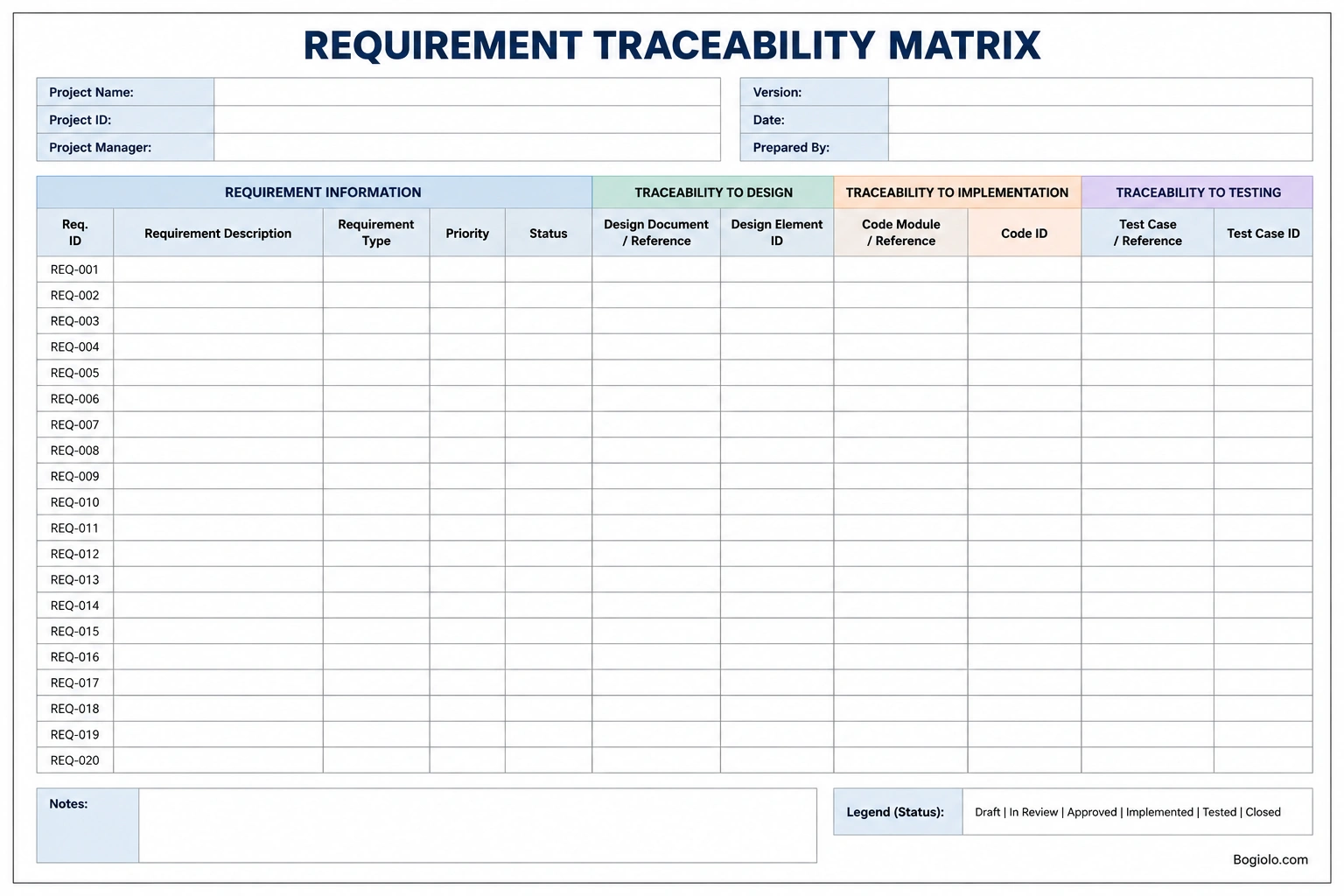
Use the printable requirement traceability matrix template below to organize project requirements and connect them to design, implementation, and testing activities. Its structured layout includes space for requirement descriptions, priorities, statuses, design references, code references, and test case identifiers.
The template can be used during project planning, software development, system implementation, quality assurance, and project reviews. Print a copy for meetings or use it as a reference when updating your project tracking spreadsheet.
Why Is a Requirement Traceability Matrix Important?
Project requirements can become difficult to manage when multiple teams, documents, and deliverables are involved. A requirement traceability matrix creates a shared reference that makes these relationships easier to understand and maintain.
1. Prevents Missing Requirements
Without a clear tracking process, a requirement may appear in a project specification but never make it into the final product. An RTM helps teams identify requirements that have no linked design, implementation reference, or test case.
2. Improves Testing Coverage
Connecting requirements to test cases helps testers confirm that the product meets its intended specifications. It also highlights requirements that have not been tested or have failed verification.
3. Supports Change Management
When a stakeholder changes a requirement, the team can use the matrix to identify related design documents, code modules, and test cases that may need updating. This makes it easier to estimate the impact of a change before approving it.
4. Reduces Project Risks
Unclear requirements and incomplete testing can lead to rework, delays, defects, and unexpected costs. Regularly reviewing traceability links helps teams discover gaps earlier, when they are generally easier to resolve.
5. Strengthens Communication and Accountability
A shared matrix gives project managers, business analysts, developers, testers, and stakeholders a consistent view of requirement progress. Clear identifiers and status fields also make it easier to discuss outstanding issues and assign follow-up actions.
What Should a Requirement Traceability Matrix Include?
The columns in a requirement traceability matrix depend on the project’s complexity and documentation needs. A practical template should include enough information to identify each requirement, locate its related artifacts, and track its current status.
- Requirement ID: A unique identifier for each requirement, such as REQ-001 or REQ-002.
- Requirement Description: A concise statement explaining what the system or project must do.
- Requirement Type: The category, such as functional, nonfunctional, business, technical, or regulatory.
- Priority: The relative importance of the requirement, such as High, Medium, or Low.
- Status: The current state of the requirement, such as Draft, In Review, Approved, Implemented, Tested, or Closed.
- Design Document or Reference: The document, specification, diagram, or design record associated with the requirement.
- Design Element ID: A specific component or design element that addresses the requirement.
- Code Module or Reference: The relevant software module, feature, or implementation record.
- Code ID: A useful identifier, such as a component ID, ticket number, or repository reference.
- Test Case Reference: The test case or verification procedure used to check the requirement.
- Test Case ID: A unique test identifier that helps the team locate the corresponding test and its results.
- Notes: Additional information about dependencies, open issues, decisions, or required follow-up.
For more complex projects, consider adding columns for requirement owners, source documents, acceptance criteria, risk levels, change history, verification results, and approval dates.
How to Create a Requirement Traceability Matrix
Creating an RTM is easier when the team follows a consistent process. The following steps provide a practical starting point.
Step 1: Collect and Review Requirements
Gather requirements from approved project documents, stakeholder interviews, business specifications, user stories, contracts, or regulatory sources. Check that each requirement is clear, testable, and properly approved before adding it to the matrix.
Step 2: Assign Unique Requirement IDs
Give every requirement a unique identifier. Use a consistent naming convention, such as REQ-001, REQ-002, and REQ-003. Avoid reusing IDs when requirements change or are retired, because stable identifiers make historical tracking easier.
Step 3: Link Requirements to Design Documents
Identify the design specifications, diagrams, interfaces, or system components that address each requirement. Record the relevant document references and design element IDs so reviewers can quickly find supporting information.
Step 4: Connect Requirements to Implementation
Link each requirement to the relevant code module, development task, configuration item, or implementation record. The exact reference depends on the project’s workflow. For example, a team may use a development ticket or component identifier instead of a direct code reference.
Step 5: Map Requirements to Test Cases
Identify the test cases that verify each requirement. Make sure the tests cover the requirement’s acceptance criteria and expected behavior. If a requirement has no test case, investigate whether the verification plan is incomplete or whether another suitable verification method is needed.
Step 6: Update Status and Review Traceability
Update the matrix as requirements are reviewed, approved, implemented, and tested. During project reviews, check for missing links, failed tests, outdated references, and requirements that have changed without corresponding updates to design or implementation.
Step 7: Maintain the Matrix Throughout the Project
Requirement traceability is not a one-time task. Establish ownership for maintaining the matrix and update it whenever a requirement or related artifact changes. For larger projects, consider using version control or requirements management software to preserve an audit trail.
Types of Requirement Traceability
Teams may use different forms of traceability depending on the direction and purpose of the tracking.
Forward Traceability
Forward traceability connects each requirement to the design, implementation, and testing activities that fulfill it. It helps teams confirm that approved requirements have been addressed and verified.
Backward Traceability
Backward traceability, also called reverse traceability, starts with a deliverable or test and links it back to an approved requirement. This helps identify work that does not support a documented requirement and may reveal unnecessary features or scope changes.
Bidirectional Traceability
Bidirectional traceability combines forward and backward tracking. It allows teams to move from a requirement to its related artifacts and from an artifact back to the requirement that justifies it. This approach is particularly useful for complex, regulated, or high-risk projects.
Requirement Traceability Matrix Example
Consider a project to develop an online customer portal. The team needs to ensure that users can sign in securely and reset forgotten passwords.
- Requirement ID: REQ-001
- Requirement: The system must allow registered users to reset forgotten passwords.
- Priority: High
- Design Reference: Authentication design specification
- Implementation Reference: Password reset service
- Test Case: TC-014, verifying that a valid reset request allows a user to create a new password.
- Status: Implemented; testing in progress.
This example shows how one requirement can be linked to several project artifacts. The team can quickly identify where the requirement is documented, how it is implemented, and which test verifies its behavior.
In a real project, the matrix should also record the actual test result, relevant defect references, and any remaining actions. A requirement should not be marked as fully verified merely because a test case has been created; the required verification must be completed and its outcome recorded.
Best Practices for Maintaining an RTM
A requirement traceability matrix is most useful when it remains accurate, readable, and connected to the team’s normal workflow. Apply these practices to keep it reliable.
- Use consistent identifiers: Keep requirement, design, code, and test references unique and easy to search.
- Keep descriptions specific: Write requirements in clear language that can be linked to measurable acceptance criteria.
- Assign ownership: Decide who is responsible for updating the matrix and reviewing incomplete links.
- Update records promptly: Record approved changes and new artifacts as work progresses rather than waiting until the end.
- Review both directions: Check that every requirement has appropriate coverage and that project artifacts can be justified by requirements where applicable.
- Track verification results: Distinguish between a test that is planned, a test that has been executed, and a test that has passed.
- Use tools appropriate to the project: A printable worksheet or spreadsheet may be sufficient for a small project, while larger teams may benefit from dedicated requirements management software.
- Protect document integrity: Use suitable access controls, version history, and review procedures when the matrix contains sensitive project information.
Common Requirement Traceability Matrix Mistakes
Even a well-designed template can become ineffective if the team does not maintain it properly. Avoid these common problems:
- Leaving links blank: Missing design, implementation, or test references make it difficult to confirm coverage.
- Using vague requirements: Requirements that cannot be clearly interpreted or verified are difficult to trace effectively.
- Failing to update changes: An outdated matrix may point to documents, code, or tests that no longer reflect the current system.
- Confusing test creation with test completion: A requirement is not necessarily verified just because a test case exists.
- Adding unnecessary complexity: Too many columns can make the matrix difficult to maintain. Include fields that support real project decisions and compliance needs.
Frequently Asked Questions
What is the main purpose of a requirement traceability matrix?
The main purpose of a requirement traceability matrix is to track each requirement and link it to relevant project artifacts, such as design documents, implementation components, and test cases. It helps teams confirm that requirements are addressed and properly verified.
Who uses a requirement traceability matrix?
Project managers, business analysts, software developers, quality assurance engineers, testers, systems engineers, and auditors may use an RTM. The specific users depend on the project’s size, industry, and documentation requirements.
What is the difference between an RTM and a test matrix?
A requirement traceability matrix connects requirements to multiple artifacts across the project lifecycle, including design and implementation. A test matrix typically focuses on test coverage, test conditions, or the relationship between test cases and features. The two documents can overlap, but their scope may differ.
Can I create a requirement traceability matrix in Excel?
Yes. Excel and other spreadsheet applications are practical options for creating an RTM, especially for small and medium-sized projects. A spreadsheet can support filters, sorting, status tracking, and links to project documents. Larger or highly regulated projects may require more specialized tools.
When should a requirement traceability matrix be updated?
Update the matrix whenever a requirement is added, revised, approved, implemented, or retired, and whenever related design documents, code modules, or test cases change. Regular reviews help prevent gaps from remaining unnoticed.
What is the difference between forward and backward traceability?
Forward traceability follows requirements toward their design, implementation, and verification activities. Backward traceability follows an artifact or test back to the requirement it supports. Bidirectional traceability uses both approaches to provide a more complete view of project coverage.
Is a requirement traceability matrix mandatory?
Whether an RTM is mandatory depends on the project’s contract, industry, quality system, regulatory obligations, and internal procedures. Even when it is not formally required, it can be valuable for projects with complex requirements, multiple teams, or significant testing needs.
Conclusion
A requirement traceability matrix is a practical tool for managing project requirements from planning through implementation and verification. By linking requirements to design documents, code modules, and test cases, teams can identify missing work, improve test coverage, manage changes, and communicate progress more effectively.
Start with a simple structure that fits your project’s needs, assign unique requirement IDs, and keep the information updated throughout the project lifecycle. Use the printable requirement traceability matrix template from Bogiolo.com as a convenient reference for organizing requirements and maintaining clear traceability across your project.
Download: Requirement Traceability Matrix Template
