Clearly defined roles and responsibilities help teams work together more effectively. When everyone understands their duties, priorities, and expectations, it becomes easier to complete tasks, avoid confusion, and achieve shared goals. Whether you manage a small business, lead a project, or coordinate a department, defining who does what is an important step toward better performance.
Roles and responsibilities explain what a person is expected to contribute and which tasks they are accountable for. They help employees understand their positions, support managers in assigning work, and give teams a common understanding of how individual efforts contribute to organizational success.
In this guide, you will learn what roles and responsibilities mean, why they matter, how to define them, and how to create clear examples for different positions. You will also find practical tips for improving teamwork, accountability, and workplace productivity.
What Are Roles and Responsibilities?
Roles and responsibilities describe the expectations associated with a position, team, or project. Although the terms are closely related, they refer to different aspects of work.
What Is a Role?
A role describes a person’s position or function within an organization or team. It explains why the position exists and how it contributes to a larger objective.
For example, a project manager coordinates activities, monitors progress, and helps ensure that a project meets its objectives. A marketing specialist promotes products or services, while a human resources professional supports recruitment and employee-related processes.
What Are Responsibilities?
Responsibilities are the duties, obligations, and expected outcomes associated with a role. They describe the work a person is expected to perform and the results they are expected to support.
For example, a project manager may be responsible for maintaining project schedules, coordinating team members, identifying risks, and communicating progress to stakeholders.
In simple terms, a role explains the function a person serves, while responsibilities describe the work associated with that function.
Why Are Roles and Responsibilities Important?
Clearly documented responsibilities help organizations establish expectations and coordinate work. They also make it easier to identify gaps, resolve misunderstandings, and evaluate performance.
1. Improve Clarity and Reduce Confusion
When employees understand their responsibilities, they know which tasks they should complete and which decisions they can make. Clear expectations reduce uncertainty and help prevent important tasks from being overlooked.
2. Increase Productivity
Defined responsibilities help employees focus on their priorities. Instead of spending time deciding who should handle each task, team members can concentrate on completing their assigned work and meeting deadlines.
3. Strengthen Accountability
Accountability becomes easier when responsibilities and expected outcomes are documented. Managers can review progress, provide feedback, and identify where additional support or corrective action may be necessary.
4. Prevent Overlapping Duties
When several people assume that someone else is responsible for a task, work can be delayed or forgotten. Defining ownership helps reduce duplication and makes handoffs between departments more reliable.
5. Support Collaboration
Clear responsibilities do not prevent teamwork. Instead, they help people understand how their contributions connect with those of their colleagues. Team members can coordinate their efforts while respecting each person’s responsibilities and expertise.
6. Improve Performance Evaluation
Documented expectations give managers and employees a common reference for reviewing performance. They help connect daily tasks with measurable objectives and identify opportunities for training or professional development.
Examples of Roles and Responsibilities
Roles and responsibilities vary according to the position, industry, and organization. The following examples illustrate how to describe common workplace functions and their associated duties.
Project Manager
Role: Plan, coordinate, and oversee projects to help ensure they meet agreed objectives.
Responsibilities:
- Develop project plans, schedules, and milestones.
- Assign tasks and coordinate team members.
- Monitor progress, budgets, and potential risks.
- Communicate project updates to stakeholders.
- Identify obstacles and coordinate solutions.
- Evaluate project outcomes and document lessons learned.
Marketing Specialist
Role: Support business growth by planning and executing marketing activities.
Responsibilities:
- Develop and implement marketing campaigns.
- Create or coordinate promotional content.
- Manage relevant digital marketing channels.
- Analyze campaign performance and audience engagement.
- Coordinate with sales, design, and other teams.
- Prepare marketing reports and recommend improvements.
Sales Representative
Role: Generate sales opportunities and maintain productive customer relationships.
Responsibilities:
- Identify and contact potential customers.
- Explain products or services and their benefits.
- Respond to customer questions and objections.
- Follow up on leads and sales opportunities.
- Maintain accurate customer and sales records.
- Work toward agreed sales targets.
Human Resources Specialist
Role: Support employee management and organizational workforce needs.
Responsibilities:
- Coordinate recruitment and onboarding activities.
- Maintain appropriate employee records.
- Support training and employee development.
- Communicate workplace policies and procedures.
- Assist with employee questions and concerns.
- Help maintain compliance with applicable employment requirements.
IT Support Specialist
Role: Help employees use technology effectively and maintain reliable IT services.
Responsibilities:
- Troubleshoot hardware, software, and connectivity issues.
- Install and update approved applications and systems.
- Respond to technical support requests.
- Maintain accurate records of technical issues.
- Follow organizational security procedures.
- Escalate complex problems to the appropriate technical team.
Finance Analyst
Role: Analyze financial information to support planning and business decisions.
Responsibilities:
- Prepare financial reports and performance summaries.
- Analyze revenue, expenses, and financial trends.
- Support budgeting and forecasting activities.
- Compare actual results with planned targets.
- Identify relevant financial risks and opportunities.
- Present findings to managers and stakeholders.
Roles and Responsibilities in a Project Team
Project teams often include people from different departments with different areas of expertise. Defining each person’s role helps the team coordinate tasks, manage dependencies, and deliver the expected results.
Project Sponsor
The project sponsor provides strategic support, approves major decisions within their authority, and helps secure the resources needed for the project.
Project Manager
The project manager coordinates planning, schedules, communication, risks, and delivery. This person helps the team stay aligned with the agreed scope and objectives.
Team Members
Team members complete assigned tasks, provide specialist knowledge, report progress, and communicate obstacles that could affect delivery.
Stakeholders
Stakeholders provide requirements, feedback, or approvals relevant to the project. Their involvement depends on the decisions they influence and the information they need.
For complex projects, a responsibility assignment matrix, such as a RACI chart, can clarify who is responsible, accountable, consulted, and informed for each major task.
How to Define Roles and Responsibilities Step by Step
Creating a clear responsibilities document does not need to be complicated. Follow these steps to establish expectations that employees can understand and apply.
Step 1: Identify the Main Objectives
Start by identifying the goals of the position, team, or project. Understanding the desired outcomes helps determine which responsibilities are necessary and which activities are outside the role’s scope.
Step 2: List the Main Duties
Write down the major tasks associated with the role. Use clear action verbs such as coordinate, prepare, analyze, maintain, review, develop, or communicate.
Focus on meaningful duties rather than listing every minor activity. Group related tasks into broader responsibility areas where appropriate.
Step 3: Assign Clear Ownership
Identify the person or position responsible for each task. If several people contribute, clarify who leads the work, who approves the result, and who provides support.
A task can involve multiple contributors, but its ownership should remain clear enough to prevent confusion.
Step 4: Define Expected Outcomes
Describe what successful completion looks like. Whenever practical, connect responsibilities with measurable results, service standards, quality requirements, or deadlines.
For example, instead of writing “manage customer inquiries,” specify the expected response time or the service standard the employee should follow, if one has been established.
Step 5: Clarify Decision-Making Authority
Explain which decisions an employee can make independently and which require approval. This helps employees act confidently while respecting organizational policies and management responsibilities.
Step 6: Review With the Relevant Team
Discuss the proposed responsibilities with employees, managers, and other stakeholders who work closely with the role. Their feedback can reveal missing tasks, duplicated duties, or unrealistic expectations.
Step 7: Update the Document When Needed
Roles may change when an organization grows, a project enters a new phase, or responsibilities are redistributed. Review the document periodically and update it when duties, reporting relationships, or business objectives change.
Best Practices for Writing Clear Responsibilities
A useful responsibilities document should be specific, readable, and relevant to the work being performed. These practices can help you create one that employees and managers can use consistently.
- Use clear language: Avoid vague statements and unnecessary jargon.
- Start with action verbs: Describe duties using words such as manage, coordinate, prepare, review, or maintain.
- Prioritize important tasks: List the most significant responsibilities first.
- Set realistic expectations: Match responsibilities to the position’s authority, skills, and available resources.
- Distinguish duties from outcomes: Explain both the work to be performed and the expected result.
- Clarify collaboration: Identify important handoffs and dependencies between roles.
- Review regularly: Keep the document aligned with current organizational needs.
Common Mistakes to Avoid
Even well-intentioned role descriptions can create problems when they are too vague or disconnected from actual work. Avoid these common mistakes.
- Using overly broad descriptions: Statements such as “handle everything” do not establish useful boundaries.
- Assigning conflicting duties: Clarify ownership when multiple roles contribute to the same task.
- Ignoring decision authority: Employees need to understand which decisions they can make and when approval is required.
- Creating unrealistic workloads: Review whether the assigned duties can reasonably be completed with available time and resources.
- Failing to communicate changes: Inform affected employees when responsibilities are updated.
- Measuring activity without outcomes: Evaluate results and quality, not just the number of tasks completed.
Sample Roles and Responsibilities Chart
A roles and responsibilities chart provides a quick visual reference for understanding who performs specific functions and what each position contributes. It is useful for employee onboarding, team planning, project coordination, and internal documentation.
The sample below illustrates how responsibilities can be organized by role, main duties, key tasks, and required skills. It includes examples for project management, marketing, sales, human resources, IT support, and finance.
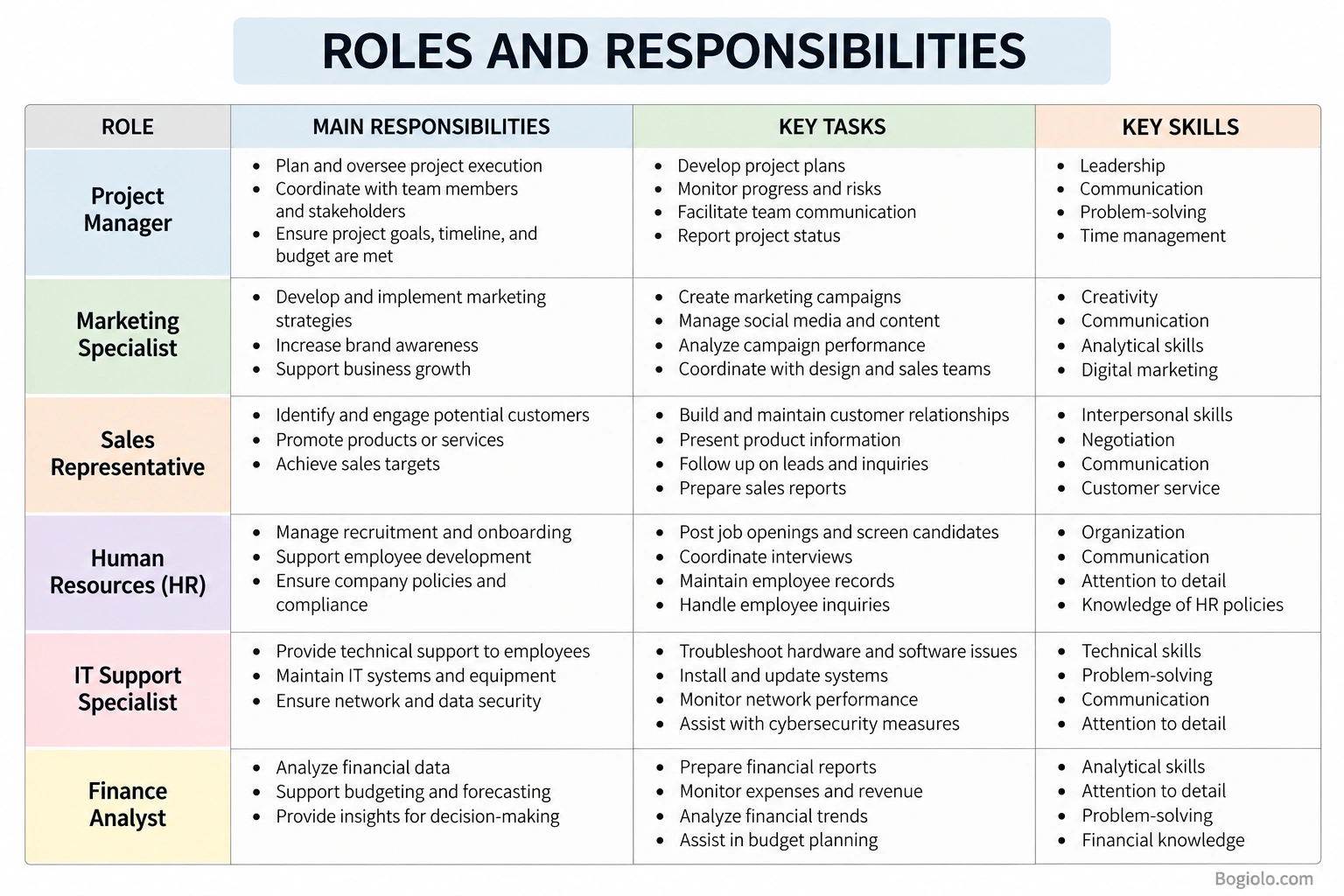
Use the chart as a starting point and adapt each description to your organization’s actual structure. Add or remove positions, revise responsibilities, and include reporting relationships or performance measures when necessary.
For more detailed projects, consider pairing a role chart with a RACI matrix or a separate job description. These documents can provide additional clarity about task ownership, approvals, and collaboration.
Frequently Asked Questions About Roles and Responsibilities
What is the difference between roles and responsibilities?
A role describes a person’s function or position within a team or organization. Responsibilities describe the specific duties, obligations, and expected outcomes associated with that role.
Why should roles and responsibilities be documented?
Documenting roles and responsibilities helps establish clear expectations, reduce overlapping duties, improve accountability, and support collaboration. It also gives managers and employees a shared reference for reviewing performance.
What should a roles and responsibilities document include?
A useful document may include the role title, purpose, main duties, decision-making authority, reporting relationships, expected outcomes, and key collaboration requirements. The exact structure depends on the position and organizational needs.
How often should roles and responsibilities be reviewed?
Review them when job duties, organizational structures, project requirements, or business priorities change. A regular review can also help identify outdated expectations and responsibilities that need clarification.
Can one person have multiple roles?
Yes. In small businesses and project teams, one person may perform several roles. The important point is to clarify the responsibilities, priorities, available resources, and decision authority associated with each role.
What is a RACI matrix?
A RACI matrix is a responsibility assignment tool that identifies who is Responsible for performing a task, Accountable for its outcome, Consulted for input, and Informed about progress or decisions. It can help clarify ownership in complex projects.
How can managers improve accountability?
Managers can improve accountability by defining clear responsibilities, agreeing on measurable expectations, providing the necessary resources, reviewing progress regularly, and giving timely feedback. Employees should also understand how to raise concerns when priorities conflict or obstacles arise.
Conclusion
Clearly defined roles and responsibilities help organizations create a more productive, collaborative, and accountable workplace. When employees understand their duties, decision-making authority, and expected outcomes, they can focus on meaningful work and coordinate more effectively with others.
To define responsibilities successfully, identify the main objectives, list important duties, assign clear ownership, establish measurable expectations, and review the document with the people involved. Update it as business needs and team structures change.
A well-organized roles and responsibilities chart provides a practical starting point for communicating workplace expectations. Adapt the examples to your organization and use them alongside job descriptions, project plans, or responsibility matrices to support better teamwork and performance.
Download: Roles and Responsibilities Template
