The roles and responsibilities of board of directors are essential to the effective leadership, oversight, and long-term success of an organization. A board of directors provides strategic guidance, monitors organizational performance, oversees financial matters, and helps ensure that the organization operates responsibly.
Whether a company is a small private business, a large corporation, or a nonprofit organization, its board members play an important role in governance and accountability. Each director contributes experience, judgment, and oversight to help the organization achieve its objectives.
Understanding these responsibilities helps organizations establish clear expectations, improve decision-making, and strengthen board performance. In this guide, you will learn about the main duties of a board of directors, individual board positions, committee responsibilities, and practical ways to organize board member expectations.
What Is a Board of Directors?
A board of directors is a group of individuals elected or appointed to provide governance and oversight for an organization. Depending on the organization’s legal structure, directors may be elected by shareholders, members, or another authorized governing body.
The board generally works with executive leadership but does not usually manage every daily operation. Instead, it focuses on strategic direction, major decisions, financial oversight, risk management, and the organization’s overall performance.
The board’s authority and responsibilities depend on applicable laws, the organization’s governing documents, and its internal policies. A corporate board, for example, may have different legal duties from the board of a nonprofit organization.
What Are the Main Roles and Responsibilities of Board of Directors?
The main responsibilities of a board of directors involve providing leadership, protecting organizational interests, and ensuring effective governance. Although specific duties vary, most boards share several important responsibilities.
1. Establish Strategic Direction
One of the board’s most important responsibilities is helping determine the organization’s long-term direction. Directors review strategic plans, evaluate major opportunities, and ensure that organizational goals support its mission and objectives.
The board may also review progress against strategic targets and request adjustments when business conditions or organizational priorities change.
2. Provide Financial Oversight
Board members are responsible for overseeing the organization’s financial health. They review financial reports, approve budgets where authorized, monitor financial performance, and ask questions about significant financial risks.
Depending on the organization, financial oversight may include:
- Reviewing annual budgets and financial forecasts.
- Monitoring revenue, expenses, and cash flow.
- Reviewing financial statements and audit findings.
- Overseeing financial controls and reporting procedures.
- Monitoring major investments and financial commitments.
The board does not necessarily prepare financial reports or manage daily accounting activities. Those tasks are generally handled by management and finance professionals.
3. Appoint and Evaluate Executive Leadership
The board typically has an important role in selecting, supporting, and evaluating the organization’s chief executive officer or equivalent senior leader. It should establish clear performance expectations and review leadership effectiveness.
For organizations with a CEO, this responsibility may include:
- Selecting and appointing the CEO.
- Approving executive compensation where required.
- Evaluating leadership performance.
- Supporting executive succession planning.
- Addressing serious leadership or performance concerns.
4. Monitor Risk Management
Every organization faces risks that could affect its operations, finances, reputation, or long-term stability. The board should oversee the organization’s approach to identifying, assessing, and managing significant risks.
These risks may include financial uncertainty, legal disputes, cybersecurity threats, regulatory changes, operational failures, and reputational damage.
Management is generally responsible for implementing risk controls, while the board provides oversight and evaluates whether the organization’s risk management framework is appropriate.
5. Ensure Legal and Ethical Compliance
Board members should promote responsible conduct and ensure that the organization has appropriate systems for meeting applicable legal and regulatory obligations.
This may involve reviewing governance policies, monitoring compliance reports, overseeing internal controls, and addressing potential conflicts of interest.
Directors should also support ethical standards, transparency, and accountability throughout the organization.
6. Evaluate Organizational Performance
The board monitors whether the organization is achieving its strategic and operational objectives. It reviews performance reports, considers important indicators, and evaluates whether management is delivering expected results.
For a corporation, this may include profitability, growth, market position, and shareholder value. For a nonprofit organization, performance may also involve mission outcomes, community impact, fundraising effectiveness, and program quality.
7. Protect Stakeholder Interests
Board members should consider the interests of the parties relevant to the organization’s governance. Depending on the organization’s structure and applicable law, these may include shareholders, members, employees, customers, donors, beneficiaries, and the wider community.
The board should make decisions in accordance with its legal duties and the organization’s purpose rather than simply favoring the personal interests of individual directors.
Roles and Responsibilities of Individual Board Members
Although the board acts collectively, individual directors may hold different positions with specific responsibilities. The following are common board roles and their typical duties.
Board Chair
The board chair provides leadership for the board and helps ensure that meetings are productive and focused on important governance matters.
Typical responsibilities include:
- Leading board meetings and managing discussions.
- Helping establish meeting agendas with appropriate input.
- Encouraging participation from all directors.
- Supporting effective communication between the board and executive leadership.
- Promoting good governance and board effectiveness.
Vice Chair
The vice chair supports the board chair and may assume the chair’s responsibilities when the chair is unavailable.
Common duties include assisting with board activities, supporting special initiatives, coordinating selected assignments, and helping maintain continuity in board leadership.
Board Secretary
The secretary is generally responsible for maintaining important board records and supporting administrative governance processes.
Typical responsibilities include:
- Preparing or overseeing accurate meeting minutes.
- Maintaining official board records and documents.
- Distributing meeting notices and relevant materials.
- Recording board resolutions and decisions.
- Supporting compliance with recordkeeping requirements.
Board Treasurer
The treasurer provides financial oversight and helps the board understand the organization’s financial position. This role is particularly common in nonprofit organizations and smaller governing boards.
Responsibilities may include reviewing financial reports, supporting budget oversight, communicating financial concerns, and working with the finance committee or accounting professionals.
The treasurer’s exact duties should be defined by the organization’s bylaws and financial policies. The role does not automatically make the treasurer responsible for every accounting or payment activity.
Board Member at Large
A board member at large participates in governance without holding a specific officer position. These directors contribute their knowledge, professional experience, and independent judgment to board discussions.
Typical responsibilities include:
- Attending and participating in board meetings.
- Reviewing reports and meeting materials.
- Contributing to strategic discussions.
- Serving on board committees when assigned.
- Supporting the organization’s mission and governance policies.
Responsibilities of the Board as a Whole
Individual directors have different assignments, but important governance decisions generally belong to the board collectively. The board should work as a unified governing body rather than operate as a collection of independent decision-makers.
Approve Major Organizational Decisions
Depending on its authority, the board may approve major strategic initiatives, significant transactions, organizational policies, budgets, and other decisions reserved for board approval.
Oversee Governance Policies
The board should establish and periodically review governance policies that explain how the organization is directed and controlled. These policies may cover conflicts of interest, ethics, board meetings, delegation of authority, and executive accountability.
Support Leadership Continuity
Succession planning helps prepare the organization for leadership changes. The board should consider how key executive positions will be filled if a senior leader leaves unexpectedly or retires.
Review Board Effectiveness
Regular board evaluations help identify strengths, weaknesses, and opportunities for improvement. The board can review its meeting practices, composition, skills, committee structure, and overall contribution to organizational performance.
Board Committees and Their Responsibilities
Many organizations establish committees to examine specific governance areas in greater detail. Committees help the board manage complex responsibilities and prepare recommendations for full board consideration.
Audit Committee
The audit committee typically oversees financial reporting, the external audit process, internal controls, and relevant financial compliance matters. Its responsibilities depend on applicable laws and governance requirements.
Finance Committee
The finance committee reviews budgets, financial performance, cash flow, and financial planning. It may provide recommendations to the full board regarding financial priorities and resource allocation.
Governance Committee
The governance committee focuses on board structure, director recruitment, board evaluations, orientation, and governance policies. It helps ensure that the board has the appropriate skills and experience to fulfill its responsibilities.
Compensation Committee
The compensation committee reviews executive compensation policies and related decisions. It may evaluate salary structures, incentives, benefits, and executive performance in accordance with the organization’s governance framework.
Risk Committee
A risk committee may review significant organizational risks, risk management policies, and the effectiveness of relevant controls. Not every organization needs a separate risk committee, as these responsibilities may be handled by the full board or another committee.
Key Expectations for Every Board Member
Serving on a board involves more than attending occasional meetings. Directors are expected to prepare, participate, exercise sound judgment, and act in accordance with their responsibilities.
Common expectations include:
- Attend meetings: Participate regularly and notify the board when attendance is not possible.
- Prepare in advance: Review agendas, financial reports, and supporting documents before meetings.
- Act in the organization’s interests: Exercise independent judgment and comply with applicable fiduciary duties.
- Maintain confidentiality: Protect sensitive information in accordance with legal and organizational requirements.
- Disclose conflicts of interest: Report personal or professional interests that could affect impartial decision-making.
- Stay informed: Understand important developments, risks, and organizational performance.
- Participate in committees: Contribute to committee work when assigned.
- Support accountability: Follow governance policies and uphold ethical standards.
How to Create a Board of Directors Roles and Responsibilities Worksheet
A roles and responsibilities of board of directors worksheet helps organizations define expectations, assign duties, and evaluate board performance. It can also be used during board orientation, strategic planning, and governance reviews.
Step 1: Identify Board Positions
List the positions within the board, such as chair, vice chair, secretary, treasurer, and members at large. Adjust the list to match the organization’s actual governance structure.
Step 2: Define Each Role
Write a clear description of each position. Include the main duties, decision-making responsibilities, and any specific committee assignments.
Step 3: Separate Individual and Collective Responsibilities
Identify which duties belong to individual officers and which decisions must be handled by the board as a whole. This helps prevent overlapping responsibilities and confusion about authority.
Step 4: Establish Expectations
Document meeting attendance, preparation requirements, ethical standards, confidentiality expectations, and participation guidelines.
Step 5: Review and Update the Worksheet
Review the document when board positions change, governance policies are revised, or the organization introduces new responsibilities. Make sure the worksheet remains consistent with the bylaws and other governing documents.
Printable Roles and Responsibilities of Board of Directors Sample
A printable roles and responsibilities of board of directors worksheet can help organizations communicate governance expectations in a clear and consistent format. It provides a useful reference for current directors, new board members, executive leaders, and governance committees.
A well-organized board responsibilities document may include the purpose of the board, key governance duties, individual officer responsibilities, and expectations for all directors. It can also serve as a starting point for board training, role clarification, and self-evaluation.
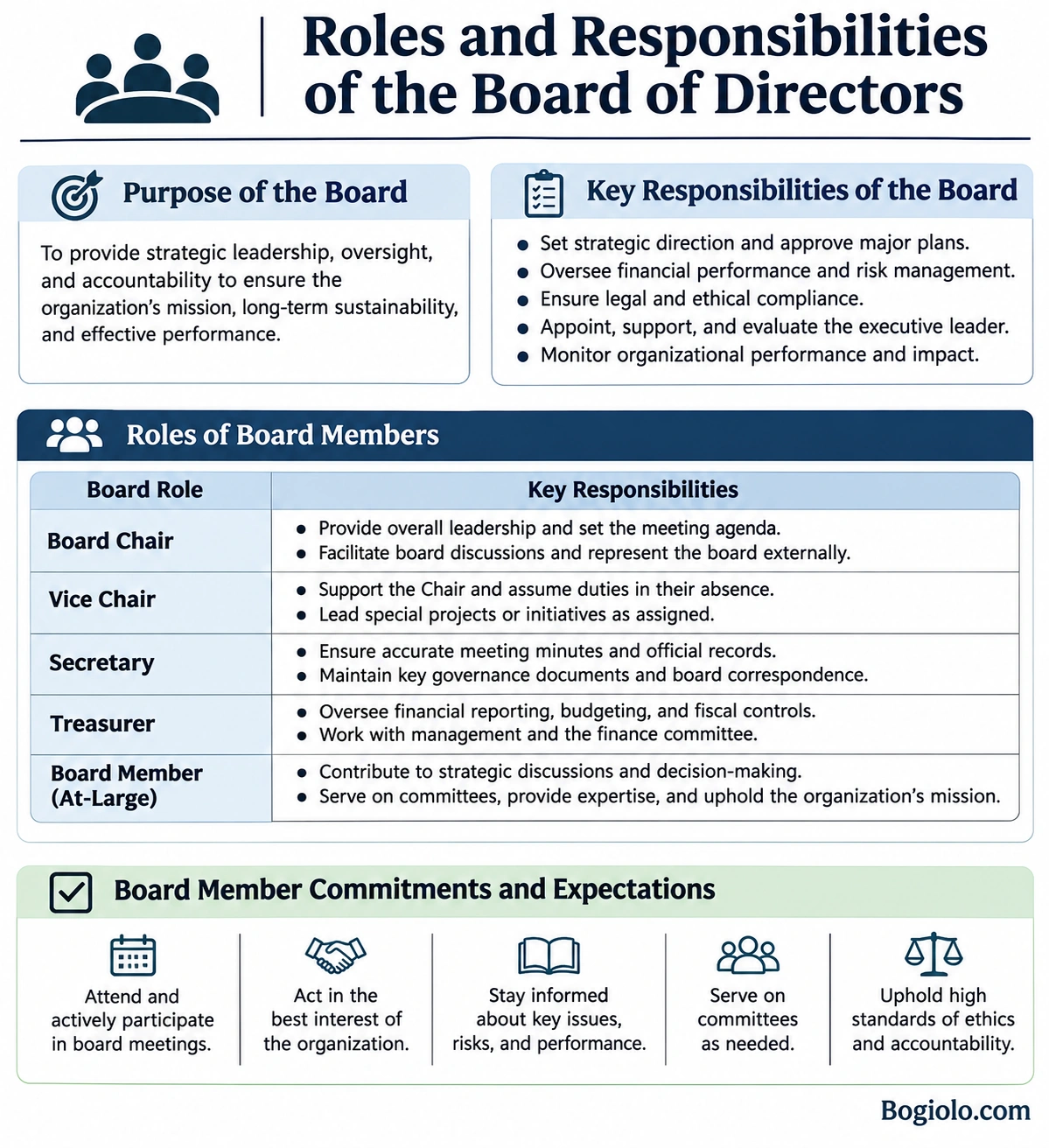
The sample below presents the main responsibilities of the board alongside common board positions, including the chair, vice chair, secretary, treasurer, and board member at large. It also highlights important expectations such as active participation, ethical conduct, informed decision-making, and committee service.
Common Mistakes in Board Role Management
Clearly defining board responsibilities helps prevent governance problems. However, organizations should also avoid common mistakes that can reduce board effectiveness.
- Unclear role descriptions: Vague responsibilities can lead to duplicated work or important duties being overlooked.
- Excessive involvement in daily operations: Boards should maintain appropriate oversight without unnecessarily taking over management responsibilities.
- Limited meeting preparation: Directors who do not review materials may struggle to make informed decisions.
- Ignoring conflicts of interest: Undisclosed personal interests can damage trust and create legal or ethical concerns.
- Weak financial oversight: Failing to review financial information can prevent the board from recognizing important problems.
- Outdated governance documents: Responsibilities should be reviewed when organizational structures or applicable requirements change.
- Lack of performance evaluation: Without regular review, the board may miss opportunities to improve its effectiveness.
Frequently Asked Questions About Roles and Responsibilities of Board of Directors
What are the five main responsibilities of a board of directors?
Five common responsibilities include setting strategic direction, overseeing financial performance, appointing and evaluating executive leadership, monitoring organizational risks, and ensuring appropriate governance and accountability. The exact responsibilities depend on the organization’s structure and applicable law.
What is the most important role of a board of directors?
The board’s central role is to provide effective governance and oversight. It helps ensure that the organization follows its purpose, makes informed major decisions, manages significant risks, and remains accountable for its performance.
What are the responsibilities of a board chair?
The board chair leads board meetings, supports effective discussions, helps establish meeting agendas, encourages director participation, and promotes good governance. The chair’s authority should be defined by the organization’s bylaws and governance policies.
What is the difference between a board of directors and management?
The board provides governance, strategic oversight, and accountability. Management is generally responsible for daily operations, implementing strategy, managing employees, and executing approved business plans. The distinction helps maintain clear authority and responsibility.
Are board members legally responsible for their decisions?
Board members may have legal duties and responsibilities under applicable corporate, nonprofit, and other governing laws. These may include duties of care, loyalty, and obedience or good-faith obligations, depending on the jurisdiction and organization type. Directors should understand the legal requirements that apply to their positions.
How often should a board of directors meet?
Meeting frequency depends on the organization’s needs, governing documents, and applicable requirements. Some boards meet monthly, while others meet quarterly or follow another schedule. Additional meetings may be necessary for urgent decisions or special matters.
What should be included in a board of directors responsibilities worksheet?
A useful worksheet should include board positions, individual responsibilities, collective governance duties, committee assignments, meeting expectations, ethical standards, and performance review criteria. It should reflect the organization’s actual bylaws and governance policies.
Can a board member serve on more than one committee?
Yes. A director may serve on multiple committees when permitted by the organization’s governance structure. Committee assignments should consider the director’s experience, available time, independence requirements, and potential conflicts of interest.
Do all board members have the same responsibilities?
All directors generally share collective governance responsibilities, but individual officers may have additional duties. For example, the secretary may maintain board records, while the treasurer may focus on financial oversight. Specific responsibilities should be documented clearly.
Conclusion
The roles and responsibilities of board of directors are central to effective organizational governance. By providing strategic direction, overseeing finances, monitoring risks, supporting executive leadership, and promoting accountability, the board helps protect the organization’s long-term interests.
Each director also has individual responsibilities that contribute to the board’s overall effectiveness. Clear role descriptions, regular participation, ethical conduct, and consistent performance reviews help ensure that board members understand what is expected of them.
Using a board of directors roles and responsibilities worksheet can make these expectations easier to communicate, assign, and review. Organizations should keep the document updated and align it with their governing documents, internal policies, and applicable legal requirements.
Download: Roles and Responsibilities of the Board of Directors
