Accounts receivable (AR) plays an important role in maintaining a company’s financial health. By managing customer invoices, tracking outstanding balances, processing payments, and following up on overdue accounts, accounts receivable professionals help businesses maintain steady cash flow and accurate financial records. A well-organized AR function also supports better customer relationships and reduces the risk of unpaid invoices.
Understanding accounts receivable roles and responsibilities is essential for employers creating job descriptions, HR teams defining position requirements, and finance managers organizing daily operations. It also helps job seekers understand what an accounts receivable position involves and which skills they need to succeed.
This guide explains the main duties of an accounts receivable specialist, common daily tasks, required qualifications, performance expectations, and practical examples that can help businesses define the position clearly.
What Is an Accounts Receivable Role?
An accounts receivable role is responsible for managing money owed to a business by its customers. These outstanding amounts usually come from products or services provided on credit. The AR team ensures that invoices are issued correctly, payments are received and recorded, and overdue balances are addressed promptly.
Depending on the size and structure of an organization, an accounts receivable employee may work independently or as part of a larger finance department. The position may also be called an accounts receivable clerk, AR specialist, billing and collections specialist, or accounts receivable administrator.
Although specific duties vary by company, the main objective remains consistent: maintain accurate customer account records and help the organization collect payments within agreed payment terms.
Accounts Receivable Roles and Responsibilities
The responsibilities of an accounts receivable professional cover several activities, from invoice preparation to payment reconciliation and collection reporting. The following duties are commonly included in an accounts receivable job description.
1. Prepare and Issue Customer Invoices
One of the primary responsibilities is preparing accurate invoices and sending them to customers on time. An invoice should include the correct customer information, products or services, quantities, prices, taxes, payment terms, and due date.
Typical tasks include:
- Preparing invoices based on approved sales orders or service records.
- Checking invoice details for accuracy and completeness.
- Sending invoices through email, customer portals, or other approved channels.
- Correcting billing errors and issuing revised invoices when necessary.
- Maintaining copies of invoices and supporting documentation.
2. Monitor Outstanding Customer Balances
Accounts receivable employees monitor unpaid invoices to understand how much customers owe and when payments are expected. Regular monitoring helps identify overdue balances before they become difficult to collect.
This responsibility often involves reviewing open invoices, updating customer account records, and checking payment statuses. AR professionals may also prepare accounts receivable aging reports to organize outstanding balances by the number of days they have remained unpaid.
3. Follow Up on Overdue Payments
Following up with customers is an essential part of the accounts receivable collection process. When an invoice passes its due date, the AR employee contacts the customer to request payment or understand the reason for the delay.
Collection activities may include:
- Sending friendly payment reminders before or shortly after the due date.
- Contacting customers about overdue invoices.
- Confirming expected payment dates and commitments.
- Documenting collection communications and follow-up actions.
- Escalating seriously overdue accounts according to company policy.
Professional communication is important throughout this process. Employees should remain polite, clear, and consistent while following the organization’s collection procedures.
4. Record and Apply Customer Payments
When customers make payments, the accounts receivable team records the transactions and applies the amounts to the correct customer accounts and invoices. Payments may arrive through bank transfers, checks, credit card processors, or other approved payment channels.
Accurate payment posting ensures that customer balances reflect the latest transactions. If a payment cannot be matched to an invoice, the AR employee may need to investigate the transaction or contact the customer for additional information.
5. Reconcile Accounts and Resolve Discrepancies
Account reconciliation helps confirm that customer balances and accounting records are accurate. Accounts receivable professionals compare invoices, payments, credit notes, adjustments, and other supporting records to identify differences.
Common reconciliation tasks include:
- Investigating short payments and duplicate payments.
- Identifying unapplied cash and missing payment references.
- Reviewing credit notes, refunds, and account adjustments.
- Correcting posting errors when authorized.
- Documenting discrepancies and their resolutions.
6. Maintain Customer Account Records
Accurate customer records help the finance department manage billing and collections effectively. AR employees maintain relevant account information, including billing contacts, invoice history, payment terms, outstanding balances, and collection notes.
They should update records promptly whenever customer details or account circumstances change. Proper documentation also makes it easier for other team members to review account activity and continue follow-up work.
7. Prepare Accounts Receivable Reports
Reporting allows finance managers to evaluate collection performance and understand the company’s outstanding receivables. Accounts receivable employees may prepare daily, weekly, or monthly reports depending on business requirements.
Common reports include:
- Accounts receivable aging reports.
- Outstanding invoice summaries.
- Cash receipts and payment application reports.
- Collection activity reports.
- Customer account statements.
- Disputed invoice and unresolved balance reports.
These reports help management identify collection risks, monitor cash flow, and make informed decisions about customer accounts.
8. Coordinate With Other Departments
Accounts receivable employees regularly communicate with sales, customer service, billing, and other finance team members. Collaboration is especially important when customers question invoice details, report missing deliveries, or request account adjustments.
For example, the AR team may work with sales to verify agreed pricing or contact customer service to investigate a complaint affecting payment. Clear communication helps resolve issues without unnecessary delays.
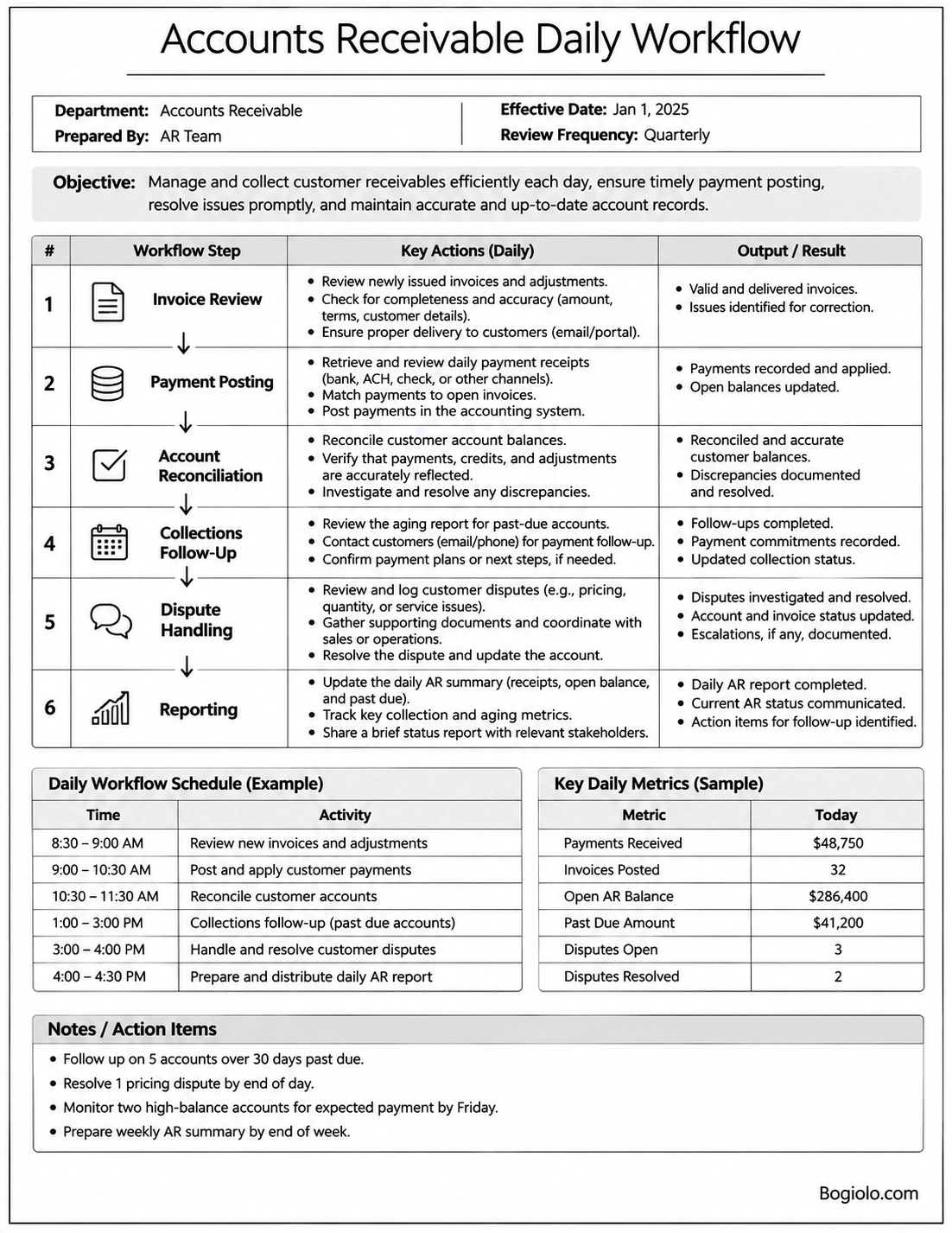
Sample Accounts Receivable Daily Workflow
An organized daily workflow helps accounts receivable employees prioritize tasks and manage customer balances efficiently. The exact schedule depends on transaction volume, company procedures, and the responsibilities assigned to the position.
A typical daily workflow may include the following activities:
- Start of day: Review new invoices, incoming payments, and account updates.
- Morning: Post customer payments and reconcile transactions against open invoices.
- Midday: Review aging reports and identify accounts requiring collection follow-up.
- Afternoon: Contact customers, investigate billing disputes, and document collection activity.
- End of day: Update account records, prepare status reports, and communicate unresolved issues to the finance team.
This workflow provides a practical starting point, but managers should adjust the sequence to match the organization’s payment cycles and operational needs.

Skills and Qualifications for Accounts Receivable Employees
Successful accounts receivable employees need a combination of accounting knowledge, technical ability, organization, and communication skills. Employers should consider both practical experience and the ability to work accurately under deadlines.
Essential Technical Skills
- Basic accounting knowledge: Understand invoices, debits, credits, payment posting, and account reconciliation.
- Accounting software proficiency: Use accounting platforms, enterprise resource planning (ERP) systems, or dedicated AR software.
- Spreadsheet skills: Work with spreadsheets to review transactions, organize customer data, and prepare reports.
- Billing and collections knowledge: Understand invoice processing, payment terms, aging reports, and collection procedures.
- Data accuracy: Enter and review financial information carefully to reduce errors.
Important Soft Skills
- Communication: Explain billing matters clearly and professionally to customers and colleagues.
- Attention to detail: Identify incorrect amounts, missing information, and unusual account activity.
- Organization: Manage multiple customer accounts and prioritize tasks effectively.
- Problem-solving: Investigate payment discrepancies and find practical resolutions.
- Time management: Meet invoice processing, reporting, and collection deadlines.
- Customer service: Handle payment questions and disputes respectfully.
Many entry-level accounts receivable positions require a high school diploma or equivalent, while some employers prefer candidates with accounting coursework, bookkeeping experience, or a degree in accounting, finance, or business. Requirements vary by organization and job level.
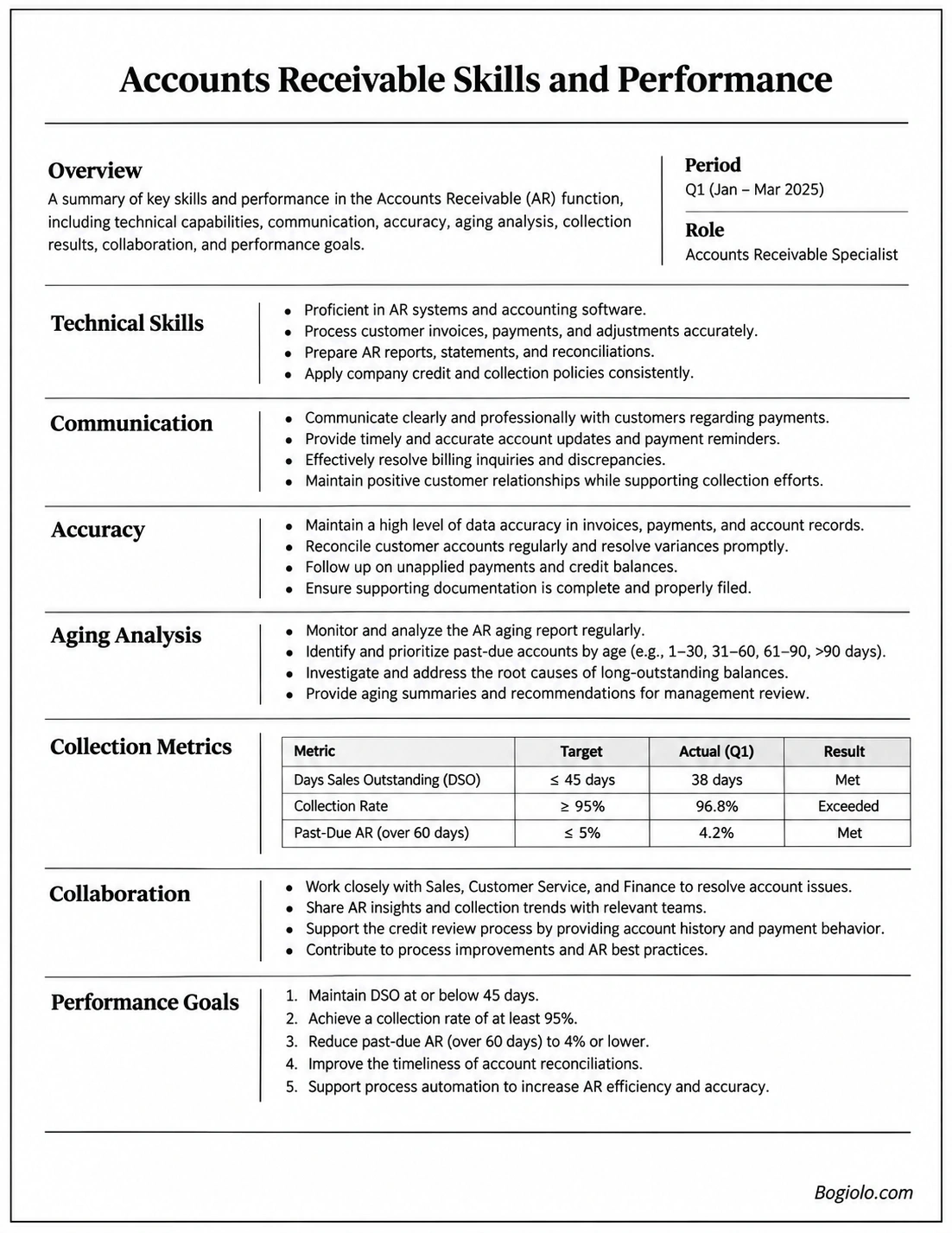
Accounts Receivable Performance Metrics
Employers can evaluate accounts receivable performance using measurable indicators. These metrics help managers understand whether invoices are processed efficiently, payments are collected on time, and account records remain accurate.
Days Sales Outstanding (DSO)
DSO measures the average number of days a business takes to collect payment after a sale made on credit. A lower DSO may indicate faster collections, although results should be interpreted in the context of the company’s payment terms and industry.
Collection Rate
The collection rate measures how effectively the AR team collects amounts due during a defined period. Management can use this metric to review collection progress and identify accounts that need additional attention.
Past-Due Receivables
This metric tracks the value or percentage of receivables that remain unpaid after their due dates. Monitoring overdue balances helps the company identify collection risks and prioritize follow-up activities.
Invoice and Payment Accuracy
Accuracy measures how often invoices, payment applications, and account records are processed correctly. Fewer errors can reduce disputes, rework, and delays in receiving payment.
Sample Accounts Receivable Job Description
Businesses can use the following example as a starting point when creating an accounts receivable job posting. Adjust the duties and qualifications to reflect the actual needs of the organization.
Job Title: Accounts Receivable Specialist
Job Summary: The Accounts Receivable Specialist is responsible for managing customer billing, monitoring outstanding balances, processing incoming payments, and supporting collection activities. This position helps maintain accurate financial records and promotes timely customer payments.
Key Responsibilities:
- Prepare, review, and distribute customer invoices.
- Monitor outstanding invoices and follow up on overdue accounts.
- Record customer payments and apply them to the appropriate invoices.
- Reconcile customer accounts and investigate discrepancies.
- Maintain accurate customer records and supporting documentation.
- Prepare accounts receivable aging reports and collection summaries.
- Respond to billing inquiries and assist with payment disputes.
- Coordinate with internal departments to resolve account issues.
- Follow company policies and applicable financial procedures.
Qualifications and Skills:
- Experience in accounts receivable, bookkeeping, billing, or a related finance role is preferred.
- Basic understanding of accounting principles and financial records.
- Proficiency in spreadsheets and accounting software.
- Strong communication and customer service skills.
- Good organizational skills and attention to detail.
- Ability to manage deadlines and handle confidential financial information responsibly.
How to Create an Effective Accounts Receivable Responsibilities Worksheet
An accounts receivable roles and responsibilities worksheet can help HR teams and finance managers document expectations in a consistent format. Rather than relying on a general job title, the worksheet should describe the actual activities and expected results for the position.
Consider including these sections:
- Position information: Job title, department, reporting manager, and review date.
- Role summary: A short explanation of the position’s purpose.
- Core responsibilities: Specific duties such as invoicing, payment posting, collections, and reconciliation.
- Daily workflow: The order or frequency of recurring tasks.
- Required skills: Technical knowledge, software proficiency, and communication abilities.
- Performance expectations: Relevant targets for accuracy, timeliness, collections, and reporting.
- Review and approval: Space for the employee and manager to confirm or discuss responsibilities.
Keep each responsibility specific and measurable where possible. For example, replace a broad statement such as “manage customer payments” with “record incoming customer payments and apply them to the correct invoices within the established processing timeframe.”
Frequently Asked Questions
What are the main roles and responsibilities of accounts receivable?
The main responsibilities include preparing customer invoices, monitoring outstanding balances, following up on overdue payments, recording incoming payments, reconciling accounts, maintaining customer records, and preparing financial reports.
What does an accounts receivable employee do daily?
Daily tasks commonly include reviewing invoices, posting customer payments, checking outstanding balances, contacting customers about overdue accounts, resolving billing issues, updating records, and preparing reports for the finance team.
What skills are required for an accounts receivable position?
Important skills include basic accounting knowledge, attention to detail, spreadsheet and accounting software proficiency, communication, organization, problem-solving, and customer service. Employers may also require previous billing or bookkeeping experience.
Is accounts receivable a bookkeeping or accounting role?
Accounts receivable is generally part of the accounting function and involves recording and managing amounts owed by customers. The position may include bookkeeping activities, but the level of responsibility depends on the organization and job title.
What is the difference between accounts receivable and accounts payable?
Accounts receivable manages money customers owe to a business, while accounts payable manages money the business owes to its suppliers and vendors. Both functions support accurate financial records and cash flow management.
How is accounts receivable performance measured?
Performance may be measured through days sales outstanding, collection rates, overdue receivables, invoice accuracy, payment processing timeliness, and the resolution of customer disputes. Companies should select metrics that reflect their business model and collection policies.
Why is an accounts receivable responsibilities worksheet useful?
A worksheet helps define job duties, clarify ownership, organize recurring workflows, and establish measurable performance expectations. It can also support employee onboarding, performance reviews, and updates to job descriptions.
Conclusion
Clearly defined accounts receivable roles and responsibilities help businesses manage customer payments, maintain accurate financial records, and support healthy cash flow. From invoice preparation and payment posting to collections, reconciliation, and reporting, each responsibility contributes to an effective AR process.
Using a structured job description worksheet makes these expectations easier to communicate, assign, and evaluate. HR teams and finance managers can adapt the sample responsibilities, skills, workflow, and performance measures in this guide to create a practical accounts receivable job description that fits their organization’s needs.
